Showing posts with label Culture. Show all posts

Monday, May 20, 2013

LEGGING IT THROUGH VIETNAM


Hobbling through Hanoi is an adventure for Liz French, even on one foot.

I didn't mind that I missed queuing to see Ho Chi Minh in his mausoleum though I would have liked to have seen the palace he never lived in and the simple peasant homes he preferred.
Instead, I was sitting on the red and yellow vinyl couch, its exploding filling taped roughly over, in the foyer of our two-star hotel with my leg up, combining ice, compression and elevation with watching Brideshead Revisited subtitled in Vietnamese.
I failed to keep my date with Uncle Ho because I was hit by a car while crossing the street on the way to the mausoleum.
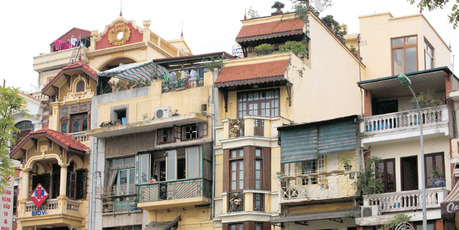
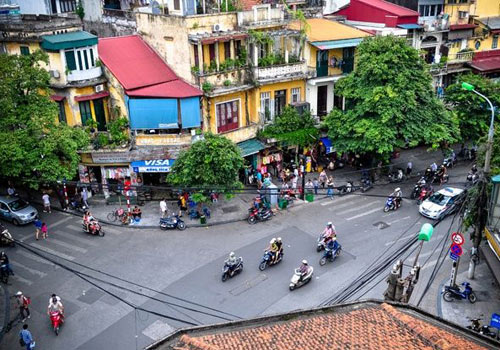
A typical Old Quarter scene in Hanoi. Photo / Helen Fritchley
Until then, in three weeks in Vietnam on an Intrepid Explorer trip involving heaps of travel, I had witnessed only two accidents - a couple of motorbike collisions in Ho Chi Minh City.
I was aware that a major road safety campaign had managed to only slightly reduce Vietnam's usual road death tally of 1000 a month but I suppose I had become a bit blase about stepping into the chaotic traffic and expecting it to weave around me.
Silly mistake. When it was all over, I couldn't put any weight on my injured ankle.
The lady driver whose side mirror I'd bounced off was distraught. And Hoang, the leader of our Intrepid group, was devastated that he had not protected me.
But in a country with little refrigeration, ice always seems to be handy. A man on a motorbike appeared with some and wrapped it in a rag round my ankle. I was ferried back to the hotel sandwiched between this stranger and Hoang. Three on a bike is nothing in Vietnam.
Another huge block of ice appeared in reception - too big to wrap, too hard to break - so I just rested against it.
When the group returned after seeing Uncle Ho, the nurse and phys ed teacher had a feel and we decided it was a bad sprain. Best I could do was stay right where I was.
Later, one of three Oriental businessmen having an hour-long portrait session in the foyer urged me to see a Chinese doctor 200m down the road. I feigned lack of comprehension.
Then the pretty receptionist extricated herself from their insistence that she appear in every photo and enthusiastically suggested that I try a traditional Vietnamese remedy for swelling. The chef would like to apply it. Well, who says the West knows best.
I did get a bit of a shock when the sweet young man who had made our omelettes that morning appeared with a flaming bowl over which was a flat dish full of wide green steaming leaves. He took each one and carefully wrapped it round my ankle as hot as I could bear.

This continued for half an hour, during which I learnt via our interpreter that though he looked 17 he was 27, had been married for a month and had used this poultice successfully on soccer injuries.
After that the receptionist kept a beady eye on me and any time I inched my leg towards the rapidly melting block she screeched: "No ice, no ice."
Sick of Vietnamese soap opera as the day progressed, I hopped to the lift up to our room for a sit-down shower, collapsing on the bed in my underwear after all the exertion. A timid knock on the door revealed my chef back for a repeat laying on of the leaves. Unfortunately, it still hurt.
That evening was the final dinner for our Intrepid group and, with departure so close, I was reluctant to get embroiled in the Vietnamese medical system.
For the dinner, Hoang, who was not much bigger than me, piggybacked me to his waiting motorbike, then up two flights of stairs at Koto ("know one teach one") Restaurant which, supported by Intrepid, equips disadvantaged young people for jobs in the hospitality industry. Coming back down after dinner was scarier and I was glad he didn't drink.
So that I could enjoy our final day in Hanoi we decided to take a taxi into the Old Quarter, known as the Venice of the East, with one of the highest population densities in the world. We would lunch at Little Hanoi, recommended by Vietnam travel, then take a scenic and shopping trip home by cyclo (a three-wheeled transport with a big seat in front of a bicycle).


The taxi dropped us at the wrong end of the street, so I hopped its length using parked motorbikes as support, only to find the restaurant was upstairs. Well, that's what bums are for.
After sharing local specialties, spring rolls and eggplant, I relaxed with a Tiger beer while my three travelling companions went for a walk and secured us some cyclos. We had quickly learnt that you always negotiate up front for any service in Vietnam and 70,000 dong (less than NZ$7 each) seemed good value.
My cyclo was wheeled across the pavement so I could barter for a jacket and a leather bag in a shop the size of a walk-in wardrobe. At the hotel, I was gently lifted out by yet another diminutive Vietnamese man.


The flights home were the next challenge. My friend Helen probably had an ulterior motive for offering to push me perched on the top of her luggage trolley. Serious shopping and the multiple garments she had bought in Hoi An meant she was over the 20kg limit while my luggage was still well under.
The minute the Malaysia Airlines check-in girls saw my predicament they frantically jabbered into the phone and jabbed at their computers. A handsome young man with a wheelchair appeared at my side to whisk me through Customs.
On the plane, invited into business class, I bounced like the Energiser bunny into privileged comfort. At the stopover, another wheelchair awaited. That was the pattern all the way home, though I got two seats rather than an upgrade on the haul to Auckland.
Back home, there was time for a shower before going for an x-ray. The ankle was broken and needed surgery. Still, it seemed no worse for having hopped around Hanoi.

Monday, March 11, 2013

FOREIGN TOURISTS IN THE CALLIGRAPHERS STREET


Recently, not only a lot of people in Hanoi and in other surrounding provinces but also many international tourists go to the calligraphers street to buy hand-drawn traditional calligraphy in Hanoi’s Temple of Literature area. 

Calligraphy is a special traditional custom in Vietnam which originated from the art of writing beautifully.
Vietnamese script and Chinese script written carefully on red paper by calligraphers has a special attraction to foreign visitors. The meaningful characters have become the symbol of luckiness, worshipping objects for thousands years in Vietnam.
Visitors come and enjoy Vietnamese traditional culture and keep memories about their trip to Vietnam on Tet holiday. They are so surprised when seeing many people, not only the old but also the young and children go to buy calligraphy in the calligraphers street. They are curious about the significance of calligraphy, the significance of giving and receiving calligraphy…
Anually, on Tet holiday Hanoi people come to the calligraphers street to buy calligraphy with many wishes. The old people pray for blessing, happiness, young people pray for a happy new year with luckiness and success…. Apart from hanging the calligraphy in the house, many people buy small-size calligraphy to put in their wallet.

A calligrapher is writing carefully a character. Most of calligrapher belong
to Huong Nam calligraphy club and UNESCO calligraphy club


Foreign tourists pay attention to the calligraphy
                                                                                Provide by http://travel.org.vn

Tuesday, January 15, 2013

Discovering Mang Lang church


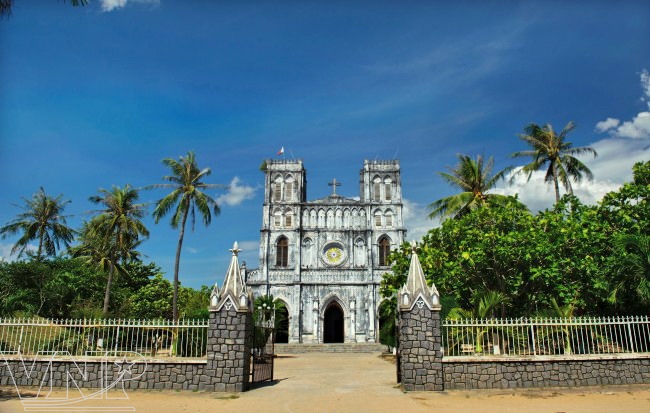
Mang Lang Church is one of the oldest churches in Vietnam imbued with an architectural style of the 19th century.
Mang Lang Church is located near the Ky Lo River, in An Thach Commune, Tuy An District, Phu Yen Province. When coming to the famous area of Nhan Mountain and the Da River, visitors do not want to miss a chance to visit the serene ancient church of Mang Lang, a popular destination.
The church was built in 1892 by Joseph de La Cassagne, a French priest, who was called Co Xuan by the locals.
The unique name of this church comes from the name of a rare variety of tree, called Mang Lang, which has a large canopy, oval leaves, and purple flowers. More than one hundred years ago, An Thach was a deserted area with forests of Mang Lang trees. Nowadays, these forests no longer exist but in the church there is still a round table made from Mang Lang wood with a diameter of 1.5m.
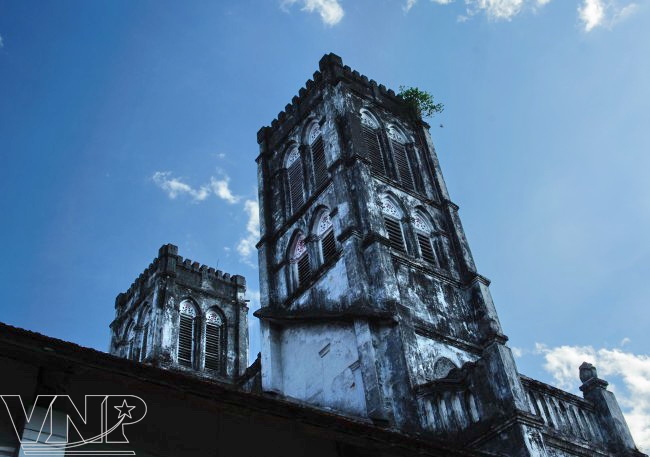
The church with an airy precinct, covering 5,000m2, is shaded by lush trees and rows of Sa-ke (breadfruit) trees, scientifically known as Artocarpus altilis. Originally, the church was painted white but it now becomes dark-grey and looks like a painting near the Ky Lo River.
The facade of the church was designed in the Gothic architectural style with two steeples, one on each side of the ancient mossy cross. Inside the church, tourists can see two dangling ropes that are used to ring the church bells on special occasions.
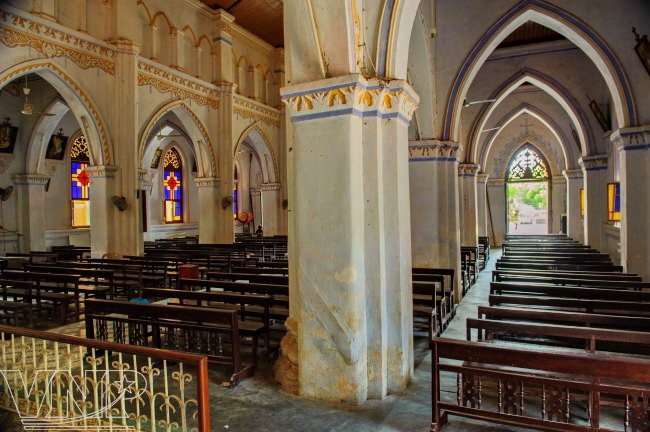
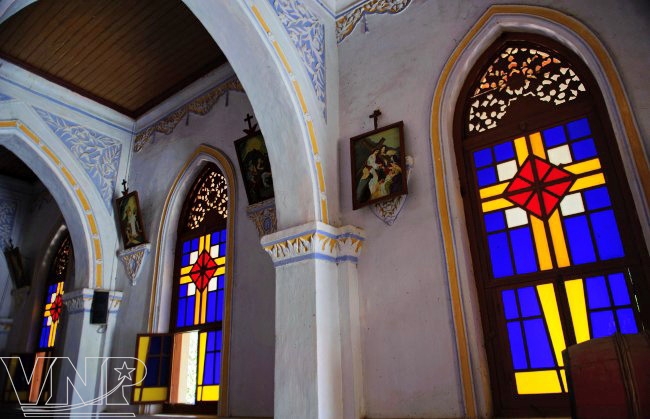
The two sides of the church’s lobby were designed in an eye-catching pyramid style. The chancel, with colorful windows, yellow-brown walls and a wooden ceiling on which ancient lights are hung, leaves a strong impression on Vietnam tourism.
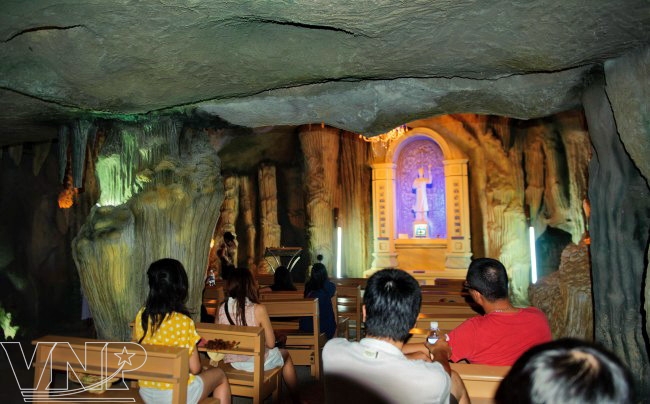
The pathway shaded by two rows of betel trees leads tourists to Mang Lang Church with its gate always open to welcome those who want to mingle in a peaceful and quiet space, separated from the bustling outside world.
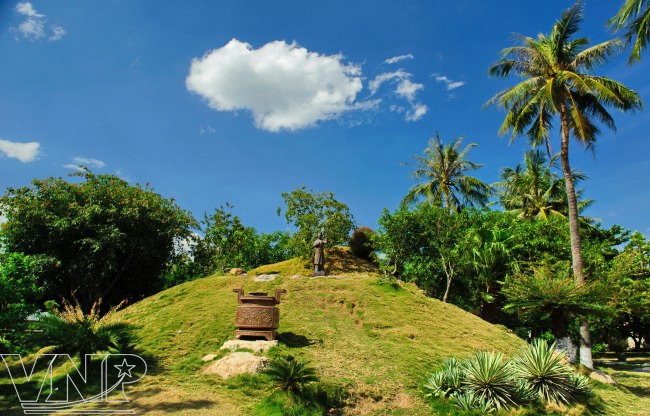
Here, tourists also behold small statues, ancient grey walls and a praying table that create a mystery and holiness for the Mang Lang Church.

Tuesday, December 18, 2012

Dong Hoi Citadel Symbolizes the brave of Vietnam

In the past, Dong Hoi Citadel held an important position in many periods of Vietnam history. Today, there is no more war in Vietnam, but the beautiful Dong Hoi citadel still stands vividly as an honorable symbol of the brave country.
Dong Hoi Citadel is located in Dong Hoi city, Quang Binh Province. It is a complex of high fences and towers, forming a fortress that protected the kings and the capital of the Nguyen dynasty since 1630. The citadel is 1'500 m away from Nhat Le beach; it is adjacent to Nhat Le River in the East side and the forest on the West side.
Dong Hoi Citadel symbolizes the brave of Vietnam
The construction of Dong Hoi Citadel was started in 1812, at the location where King Nguyen Phuc Nguyen built Tran Ninh Rampart and Dong Hai Post in 1774. When King Gia Long passed away, King Minh Mang asked a French general to re-design the citadel, and in 1824 he rebuilt it into an invincible fortress which has the shape of a star. The perimeter of the citadel is 1.860m; its height is 4m. The 1.35m-wide façade faces the West. In addition, the citadel has 3 other big gates: North, South and East, which are equipped with 8-roof towers. Each gate has a well-designed bridge which connects the citadel with the outside area. In 1842, when Kinh Thien Tri was reigning, he renovated Dong Hoi citadel to consolidate its strength.
Dong Hoi citadel held an important position in many periods of the country's history. In 1885, when the French army attacked it, people and the soldiers of Dong Ha defended and triumphantly won the battle, making the French retreat. During the Vietnam-France war from 1945 to 1954, the local inhabitants have also made several attacks at the citadel.
Nowadays, there is no more war in Vietnam, but the beautiful Dong Hoi citadel still stand vividly as a honorable symbol of the brave country, attracting tourists who travel to Vietnam.

Wednesday, November 14, 2012

A glance back to the past in Bich Dong


With the country’s second most beautiful cave, Bich Dong Temple in Hoa Lu Commune, Ninh Binh Province is a must for tourists to the area located 200 kilometres to the southeast of Hanoi.
The first Bich Dong temple
The temple was built on a limestone mountain that was formed millions of years ago and it was named in the 18th century after the beautiful white limestone which exists only in this area. The whole construction included three small temples with the first at the foot of the mountain, the second at the entrance of Bich Dong cave and the third, also the smallest, on top of the mountain, viewing the whole stunning green valley below. All three temples are made from rare wood, with tiles formed like the tail of a phoenix or the blade of the ancient weapon, seeing the construction come to life. From a distance, the temple looks like a wooden boat floating on the river. 
The temple was built in the 18th century by two monks, who admired the peaceful and seductive landscape and decided to stay and build the temple for Buddhists to worship and pray for the prosperity of the country.
From the foot of the mountain, tourists have to climb dozens of stone stairs to get to the cave’s entrance, as well as the second temple. But in order to get to the third temple, tourists have to cross the cave. Inside the cave is a bronze bell made three centuries ago by the founders as well as the worship place of Buddha and the three gods in ancient belief.
Although going through a lot of reconstruction, the beautiful temples and cave make it a destination that everyone must visit once in a lifetime.
A stone lion guards the second Bich Dong temple
The third Bich Dong temple, also the smallest, on the top of the mountain - Photos: Pham Thai

Sunday, November 11, 2012

An original art of Vietnam


According to scholars specializing in portraying art, lacquer plays the first role in traditional materials in Vietnam's painting background. Opening to the world, Vietnam's lacquer paintings have got special attention because of its distinct nuance that strongly expresses national characters.
 Yes, lacquer art has a centuries-old tradition in Vietnam, having first been introduced by the Chinese in the making of handicrafts and decorative items. In previous centuries, wooden statues in village's communal houses, temples, pagodas were red-lacquered and trimmed with gold. Altars, parallel sentences panels, and horizontal lacquered boards were handled by lacquering with sparkling colors.
Why was lacquer painting considered as an original art of Vietnam?
After the establishment of the Ecole des Beaux Arts de l’Indochine by the French in 1925, however, that anonymous craft performance became a new art form and was applied to paintings for the first time. At that time, the founders of the Ecole, Victor Tardieu and Joseph Inguimberty, recognized the beauty of the Vietnamese artistic traditions and wanted to help their students make the most of their heritage as well as teaching them Western painting. During the 20 years of its operation, the Ecole trained more than 100 Vietnamese artists who would become the pioneers of Vietnamese modern art, combining indigenous art forms with the art of Manet, Degas, Monet, Pissarro and Renoir. The 1930s was the time when lacquer paintings and other works of fine arts confronted a great renaissance. It confirmed that the ability to express ideas and feelings of lacquer paintings is unlimited.
The lacquer and colors
Lacquer is a clear sap coming from of six species of trees growing in the North and the South Vietnam, both belonging to the familyAnacardiaceae. Lacquer - a harmless substance - is harvested in the same way as rubber by making an incision and letting the sap flow. Fresh lacquer is whitish and turns brown upon exposure to air. Black lacquer stems from a chemical reaction between lacquer and iron, then, it will be mixed with various natural or artificial dyes to produce the favorable colors. Surprisingly, several shades of red are extracted from a naturally occurring red mineral, cinnabar (mercuric sulfide). White is produced from eggshell. Eggs from ducks are used because they have a better structure than hens’ eggs. The eggshells are cleaned and sometimes even burned to obtain a brownish tinge.
Several other materials may be used to make lacquer paintings; the most common are gold leaf and silver leaf. Silver is used below the layers of colors to create an effect of immense luster. Gold leaf, on the other hand, is often applied as the final layer. An interesting use of gold leaf will make it appear as bright light flowing through the window. Besides, a range of other materials may also be used, such as shells, sand, epoxy and clay.
 Applying colors and polishing
 Painting with lacquer is a long and complex process requiring great skill and patience. It may take several months, depending on the specific technique of the artist and how many layers of lacquer are included. It involves the application of many layers of lacquer on a prepared wooden board, allowing each to dry in turn, and finally polishing the painting with pumice to reveal whatever colors the artist desires in different areas of the painting. Other materials used include eggshell to produce a white color, mother-of-pearl, gold and silver leaf. The final result is smooth and durable and will not crack due to fluctuations of temperature or humidity.
However, paintings after finishing need more time to be touched. It may be months, years, even plenty of years. The painters have to whet again and again their paintings to make them flat. Paints are drawn in many layers then can bring beautiful, occult and splendid colors. If you take notice, you can realize the capabilities and preeminence of different ones. Black lacquer is shiny, glossy and profoundly mysterious while cockroach-wing lacquer is lissome and limpid. Covering golden or silver color, the other colors can change to create derivative color bringing theatrical timbre. By coordinating ages of different-aged colors, color powders also become vaporous and radiant to finally make up sunk and floated parts of the paintings.

Many lacquer paintings and art objects of Vietnam have been brought overseas in mass. Painters, much or little, often draw lacquer paintings by sudden inspiration and following their flow of emotions. Vibration in their heart is reflected through the work without any rules or formulas. Because of those factors, the spirit in Vietnam's paintings turns to be profound.
There are some painters who have strong attachment with lacquer and have published resounding paintings such as Nguyen Sang with his work "Afternoon rest"; Tran Van Can with "Miss Thuy"; Phan Ke An with the painting "Missing one evening in North west"; To Ngoc Van and "Spending the night on roadside"; Mai Van Nam with "Going to Bac Ha market"; Nguyen Van Ty with "Thatched cottage and foot of jackfruit"; Tran Đinh Tho and "Bamboo"; and Nguyen Gia Tri with "Spring Garden", "Bailing water to prevent blood", and "The girl at hibiscus mutabilis  flower".
In Vietnamese art treasure, besides lacquer paintings, there are many kinds of traditional paintings such as Dong Ho glazed paper paintings, oil-paintings, silk paintings.... Each type has its own special features that make Vietnamese people always feel proud when mentioning them with foreign friends from all over the world.

Thursday, October 25, 2012

Tay Do Night Market


Come to Tay Do night market, visitors will enjoy an interesting travel tour. The market likes a complex picture, really illustrating the daily life of residents in the downstream of famous Me Kong Delta.
About 1km far from the centre of Can Tho city to the west of Hau river, located in Can Tho International Trade Fair Centre, Tay Do market is not only the trading centre of Southern provinces but also attractive entertainment and tourism destination.
Tay Do Night Market
Although the Tay Do night market was just activated few years ago, it is considered a typical, special and fascinating cultural travel destination in Can Tho which attracts not only local people but also visitors from far. Formerly, Tay Do market is a wholesale market, exchanging products with many locales in and out of the country. Besides the task of product exchanging, there are cuisine and entertainment services there. Because of its large scale and importance to the local area, Tay Do market becomes a large trading centre of Southern provinces.
Tay Do Night Market
The architecture of Tay Do night market is harmonious with the landscape around and has the emphasized Southern style. The market is scientifically divided into stalls which are clear, neat, and aesthetical. Roads in the market are plasticized and clearly wide.
The products in Tay Do night market are very various, meeting the requirements of residents and tourists in selecting products. Besides trading activities, there are modern entertainment services in Tay Do night market such as: games, outside music shows and other programs.
Come to Tay Do night market, visitors will enjoy an interesting travel tour. The market likes a complex picture, really illustrating the daily life of residents in the downstream of famous Me Kong Delta.  

Wednesday, October 24, 2012

Buu Phong Temple


Buu Phong Temple located on Buu Long mountain in Binh Dien, Tan Buu, about 4 km from the city of Bien Hoa is a historic 17th century Buddhist temple in Dong Nai Province in southern Vietnam. 
There are 100 steps up the side of the hill from the road to the entrance of the temple. At the entrance is a large arched triple gate. At the front of the temple, there are inscriptions of verses on the wall. In front of the temple is a statue of Avalokiteshvara bodhisattva, erected in 1963.
Inside the highly decorated main hall is a historic statue of Amitabha Buddha. There is also a stupa behind the main hall where a sample of the relics of Gautama Buddha are enshrined.
Today, Bửu Long mountain has become an important tourist and historical attraction of Dong Nai Province. In the surrounding area, there are further stupas and statues which depict three key moments in the life of Gautama Buddha: his birth as Prince Siddhartha at Lumbini, his enlightenment under the bodhi tree at Bodh Gaya and the entering into nirvana at Kusinara.
Visitors in Vietnam tourism are warmly welcomed at the Buu PhongTemple and may watch ceremonies and take photos from the galleries. But tourists are only asked to wear trousers or skirts covering the knee, remove their shoes before entering, and remain as quiet as possible during ceremonies. 

Visiting Linh Son pagoda in Dalat


The road to the pagoda is different from others with some horse gnawing grass, unlike with noisy streets below with much traffic.
Located on a hill of 4ha on Nguyễn Văn Trổi Street, nearly 1 kilometer northwest of Da Lat city, Linh Son pagoda was built from 1936 to 1940 through donations from Buddhists everywhere, especially the efforts of Võ Đình Dung and Nguyễn Văn Tiếng.
The entrance path is in the shade of pine rows and immeasurably high rubbers. Right at front yard, tourists in Vietnam tours can see the statue of Avalokitesvara standing on the lotus throne, the octagonal three-storey tower on the left, and the miniature mountains with beautiful bonsai trees on the right.
There is a lake standing out in relief of green grass patch, colorful water lilies, gold fish swimming carefree, making a cheerful sight. 
The pagoda bears EastAsian architecture, with two simple down-roofs; on the top a pair of dragons meandering in worship of the Sun. Alongside the step path to the sanctuary, there are also a pair of open-mouthed dragons engraved elaborately, a symbol of Dragon Deity preserving Dharmas. 
The Buddha’s altar inside is decorated solemnly. The sanctuary is used for the worship of Buddha Shakyamuni deeply meditating in ecstasy on the lotus throne. The statue was cast of brass in 1952, weighting 1250 kg. 
Most Venerable Thích Từ Mẫn has been the highest superior since 1964 and Buddhism’s Managing Council of Lam Dong province has its office here.

Monday, October 22, 2012

Nguyen Trung Truc Temple Festival


From the 18th to the 19th day of the tenth lunar month, Nguyen Trung Truc Temple Festival is annually organized in Long Kien Commune, Cho Moi District, An Giang Province.
The temple is dedicated to Nguyen Trung Truc, the leader of an insurrection who rose up against the French in the South. Among other exploits, he led the raid that resulted in the burning of the French warship Esperance. Despite repeated attempts to capture him, Nguyen Trung Truc continued to fight until 1868, when the French took his mother and a number of civilians hostage and threatened to kill them, he did not surrender. Nguyen Trung Truc turned himself in and was executed by the French in the market place of Rach Gia on 27 October 1868.
The first temple structure was a simple building with a thatched roof; over the years it has been enlarged and rebuilt several times. The last reconstruction took place between 1964 and 1970. In the centre of the main hall is a portrait of Nguyen Trung Truc on an altar.
In the festival, the locals organize incense-offering ceremony, recalling sacrifices-offering ceremony, reperformance of the battle of destroying a French warships on the Nhat Tao River in the 19th century. The festival involves boat rowing, Chinese chess and other fun games.
Since 2003, Nguyen Trung Truc Temple Festival has been considered as one of national cultual events with many typical entertainment activities. The festival attracts hundreds of visitors to participate. Beside traditional ceremory, a cultural program is held for the purpose of cultural exchange between ethnic groups of Kinh - Hoa – Khmer. Moreover, there remains a number of interesting folk games.
Visiting An Giang Province on the occasion of Nguyen Trung Truc Temple Festival, you will be able to explore and understand the cultural beauty in the region...

Yen Tu Festival

A popular saying goes: "Even after 100 years of virtuous religious life, if you don't come to Yen Tu you cannot be called a true religious person". Pilgrimage to Yen Tu Festival in respect of Buddha and sightseeing is so meaningful...

Situated within the immense arched mountain range of north-eastern Vietnam, Yen Tu Mountain in northern coastal Quang Ninh Province bears at its peak the Dong Pagoda: at an altitude of 1,068m above sea level. The beauty of Yen Tu consists in the majesty of its mountains mingling with the ancient and solemn quietness of its pagodas, shrines and towers. Yen Tu has been a centre of Buddhism for many centuries, and is the starting point of the Buddhist sect of Truc Lam. Travellers to Yen Tu Festival to stay away from the mundane and go on a religion pilgrimage in the midst of the mighty nature.
The history...
Under the Ly Dynasty, Yen Tu held the Phu Van Pagoda, with Yen Ky Sinh as its warden. But Yen Tu only really became a Buddhism centre when Emperor Tran Nhan Tong surrendered his throne to establish a Buddhist sect called Thien Truc Lam and became the first progenitor with the religious name Dieu Ngu Giac Hoang Tran Nhan Tong (1258-1308). He ordered building hundreds of constructions, large and small on Yen Tu Mountain for leading a religious life, sermonizing. After his death, his successor, Phap Loa Dong Kien Cuong (1284 - 1330) the second progenitor of Thien Truc Lam, compiled a set of book “Thach that ngon ngu” and ordered the building of 800 pagodas, shrines and towers with thousands of value statues throughout 19 years of religious life. Some famous pagodas are Quynh Lam, Ho Thien. There is the third progenitor of Thien Truc Lam, Huyen Quang Ly Dao Tai (1254 - 1334), in the sermonizing centre of Phap Loa.
Passing through to the Le and Nguyen Dynasties, Yen Tu became the focal point of Vietnamese Buddhism, and was often subject to restorations. It is a meeting place of different styles from various historic periods: visible in the many different designs and decorations that ornate its constructions.
The mountain scenery and beautiful pagodas and hermitages, inspired King Tran Nhan Tong, who reigned over the country from 1279 to 1293, to pass the throne to his son to lead the life of a Buddhist monk at Yen Tu. There, he founded the Truc Lam medication sect, making Yen Tu the country’s leading Buddhist center.
... and the festival

Yen Tu Festival commences annually on the 10th day of the first lunar month and lasts for three months. Tens of thousands of pilgrims begin their journey to the uppermost shrine after a solemn ritual held at the base of Yen Tu Mountain.
During the festival, the people near and far flock to Yen Tu which was regarded as the Buddhist land to show their belief and aspiration or to get rid of all sorrows and sadness. Other go to Yen Tu to do sightseeing and to enjoy the pure atmosphere of a mountain region. Foreign visitors come to Yen Tu to witness a famous beauty spot, a mysterious tourist attraction. Many cultural and historical values are carefully preserved in Yen Tu, where is also home to a rare ecosystem in Vietnam.  
In the wide ensemble of vestiges in Yen Tu, there are 11 pagodas and hundreds of shrines and towers. One form of entertainment is to climb the peak to where the Dong Pagoda was built (1,068m above the sea). On the way, you will see pagodas, a tower, a stream and a forest. At the top, after having burned joss-sticks, you seem to be lost in nature somewhere between the sky and the earth. When clear, you can perceive almost all of the northeast area from here.
Dong Pagoda
The route of the pilgrimage from the foot of the mountain to the pagoda is nearly 30 km. The highest point of Yen Tu is Dong Pagoda, which is located 1,068 m above sea level. You can get to Hoa Yen Pagoda at the altitude of 534m by the cable car system recently put into operation and will see on this peak two 700-year-old frangipane trees. From there, you will continue walking up stairs to pagodas of minor note lined up along the path leading to Dong Pagoda. There you will feel like walking on clouds. If the weather is agreeable, from this summit you can admire the dramatic landscape of the northeast of Vietnam.
The complex of historical sites and beauty spots in Yen Tu features various pagodas, shrines or stupas now appearing now disappearing under the thick foliage of the primary show their belief, or doing away with all sorrow and sadness. Others go to Yen Tu to do sightseeing and to enjoy the pure atmosphere of a mountain region. Foreign visitors come to Yen Tu to witness a famous beauty spot, a mysterious tourist attraction. Anyone who makes all the way to the Bronze Pagoda feels the magnificence of Yen Tu and forests. Atop Yen Tu Mountain, one feels like standing by the Heave Gate shrouded in white cloud. On clear days one can have a partial view of the northeastern region...