Showing posts with label Travel. Show all posts

Tuesday, November 12, 2013

Mekong delta

Mekong delta is located in Southwestern Vietnam. In Vietnamese, it was called Cuu Long. It means Nine Dragons for the nine months that terminate the flow of this great river as it is absorbed by the sea. Its total area is around 39.734km2 and include provinces: An Giang , Ben Tre, Bac Lieu, Ca Mau, Can Tho, Dong Thap, Hau Giang, Kien Giang, Long An, Soc Trang, Tien Giang, Tra Vinh, Vinh Long.


Mekong delta is well-known as the biggest rice-growing region in the country.  Other products of the delta include coconut, sugar cane, fruit and fish.The main towns of the delta are My Tho, Vinh Long, Can Tho and Chau Doc. My Tho is the first stop when you go from Ho Chi Minh city to the delta. It is popular with a taste of authentic delta life. Here tourist can take Sampan along the waterways, visit tropical fruit orchards and enjoy the local delicacy, Elephant’s Ear Fish. Then you will come Vinh Long. It is the island in Mekong River.  Coming there you have a chance to take part in Floating Markets in which all kinds of product are traded from boats. To make shopping easier, the boats suspend a sample of what they sell from the top of a long pole. 


Besides, you can visit small riverside workshops including blacksmiths, rice huskers, thatchers and coffin makers. Contemplating local orchards, flower markets and fish farms is other interesting activities when you come Mekong delta.  
Say goodbye to Vinh Long, you will come Can Tho. It is a commercial center of the Mekong Delta. Here you can visit the biggest floating- Cai Rang Floating Market in the morning. A spectacular sight outside of town is the stork garden at Thot Not where hundreds of egrets, herons and cormorants gather in the treetops to roost late in the afternoon. 


The last place is Chau Doc. It is located at the foot of Sam moutain on the Cambodian border. Here you can enjoy the large Cham, Khmer and ethnic Chinese communities and the distinctive architectural styles of each community can be seen in their places of worship around the town. 


You can take a boat trip to see the unusual floating fish farms, houses with wooden pens suspended underneath where live fish are kept. You will get exciting experiences in Mekong delta which nowhere can bring to you. Let come and discover by yourself

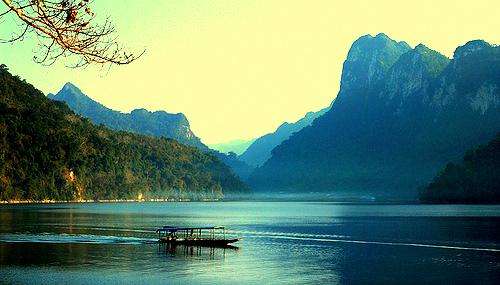
Ba Be

Ba Be is a rural district of Bac Kan province in the northeast region of Vietnam. Ba Be has diversity flora and beautiful natural scene. The famous destination is Ba Be National Park which is a popular Vietnam’s natural complex mainly consisting of Ba Be Lake, the supposed largest natural fresh water lake in Vietnam. The 150m altitude makes it the Vietnam’s highest lake above sea level.


Located in the Nam Mau Commune, Ba Be District, Bac Kan Province and about 220 km from Ha Noi, Ba Be Lake is one of the top 100 freshwater lakes in the world and the largest one in North of Vietnam. 

The name Ba Be comes from its water sources those are the three branches, Pe Lam, Pe Leng and Pe Lu. Ba Be Lake is 650 hectares width, 145 meters altitude, 8 kilometers length, 20-25 meters average depth and be surrounded by the limestone mountains with caves and underground streams. 


Due to favorable position, at the centre of the Ba Be National Park, Ba Be Lake is the home to a giant fauna with 81 kinds of animal, 27 kinds of reptile, 322 kinds of bird, 106 kinds of fish and 553 kinds of insect and spider.  In 1995, Ba Be Lake was recognized as one of the 20 special freshwater lakes in the world.

In 2004, ASEAN also recognized it as the Heritage Garden. And now Ba Be Lake, with Ba Be National Park, is one of the most precious gems of Vietnamese tourism and an ideal ecological site for any visitors, especially spring and summer.

Wednesday, September 11, 2013

Most Popular Tourist Attractions in Vietnam

Vietnam is a country that is situated in the Southeast Asia. It was once a country ravaed by war, now, Vietnam has opened its doors to tourists that it is now fast becoming a must-go place in Asia, and here are most popular places that one should visit and see in Vietnam.
Vinpearl Amusement Park, Nha Trang 
 
Coming to Vinpearl Park (Vinpearl Land), you will have exciting experiences with your family. Best of all, this spectacular fun park is located in the popular beach resort town of Nha Trang, which is home to some of the best beaches in Southeast Asia. There is lots of fun stuff you can do in Vinpearl like playing water games, driving the bumper cars, play arcade games and ride the water slides.
However, the interesting thing about the park is being able to ride the famous Vinpearl cable car, which is the longest in the world and offers stunning panoramic views over the entire city of Nha Trang.
Halong Bay, Quang Ninh

Halong Bay is a popular tourist destination and one of the most beautiful places in Vietnam with its unusual rock formations, islands and caves such as the famous Kissing Rocks, Sung Sot Grotto (Cave of Surprises), Hoang Tan Island, Hon Trong Mai, Bai Tho Mountain, Thien Cung grotto (Heavenly Cave) and Cat Hai Island. 
War Remnants Museum, Ho Chi Minh City

The War Remnants Museum is a war museum at 28 Vo Van Tan, in District 3, Ho Chi Minh CityVietnam. It primarily contains exhibits relating to the American phase of the Vietnam War. It may not be everyone’s cup of tea but it’s another tourist attraction you can’t miss visiting in Vietnam. You can’t really say you’ve been to Vietnam unless you’ve visited the War Museum and learn about the Vietnam War from a Vietnamese point of view. 
The museum illustrates history through video and photos the horrors of war and more particularly the use of chemical warfare during the American-Vietnamese conflict. There are also dozens of artifacts on display that you can loo at such as tanks, helicopters, bomb shells and more.

Hanoi Old Quarter


The Old Quarter is the heart and soul of Vietnam. It’s truly a fascinating place to explore anytime of day because this part of town never sleeps and it’s bustling everywhere with shops and food vendors selling tasty delicacies.
Hanoi is packed with hundreds of tourist sights and interesting places such as the Old Quarter of Hanoi, which is unarguably one of the most popular tourist attractions in Vietnam.
Coming here, you should spend time wandering the famous streets of Ma May and Hang Buom, shop at Dong Xuan market and taking a boat ride of Hoan Kiem Lake. By the way, be sure to hire a cyclo (bicycle rickshaw) or hop on a “Green Tourism electric bus” to explore the Old Quarter, your feet will love you for it!

Imperial City, Hue
 
Hue Imperial City is definitely one of the most visited historic sites in Vietnam. The walled city of Hue spans a one-mile area and it is truly an impressive feat of architectural wonder given its size. Visitors to Hue would like to wander freely through the site and explore the rooms of the palace and the beautiful courtyard of the imperial enclosure.

In addition, make sure you visit the Tu Duc Tomb while in Hue. The tomb is located in Duong Xuan Thuong village (not far from the center of Hue) and it’s another sight that you have to see because of its scenic location, beautiful gardens and stunning pagodas.

Paying a visit to Saint Giong Temple

Saint Giong Temple, also called Soc Son Temple, is located in Soc Son District of Hanoi, 40km from the city center.
Soc Son Temple is o­ne of the oldest and most holy sites in Vietnam. Coming here, visitors will hace a chance to be far from the bustle of Hanoi. The temple is built at the foot of the Horse Mountain which was believed to be the place where Saint Giong stopped for a rest after fighting off the invaders restoring peace to Vietnam...
Soc Son Temple is surrounded by mountains: Mt. Cao Tung to the South, Mt. Cấm to the East, Mt. Cổ Ngựa to the West, and the Mt. Rứa and a piece of flat land to the Southeast. In the ancient past, these mounts were covered with thick forests. The area is also bathed by two rivers: one following from the North-West to the South-East, the other from the West to the South.
According to the legend, After defeating the Ân invaders, hero Dóng galloped to the top of Mt. Sóc, then hanged his suit of armor on a scandal-wood tree, and vanished into the sky with his iron horse.
In commemoration of the event, a festival is held every year in Sóc Sơn Temple, involving festivity, the Mộc Dục ceremony, the Bamboo flowers procession, the Elephant procession, the Betel plant procession, the Paper boat rituals, and the beheading of the enemy commander.
Nowadays, visitors can walk among these temples, pray to Thanh Giong and generally soak up the ambience of the area. Anywhere at the foot of the mountain makes a great picnic spot, but those feeling a bit more athletic can climb the steps to the top of the mountain.
During Tet, Soc Son also hosts o­ne of the country’s biggest festivals. o­n the sixth, seventh and eighth days of the Lunar New Year, it becomes an explosion of colour, religion and tradition. Big crowds, processions and even an amusement park for kids appear as if from nowhere. At other times of the year, guests tend to be in the form of school trips bused in from Hanoi. They climb the mountain, are taught the religious and mythological significance of the place, recount their achievements for the year, make resolutions and even listen to Vina-house while playing tug-of-war. Other visitors are worshippers, daytrippers and the occasional foreigner.

Bac Giang: "Da Huong" ancient tree

Da Huong tree in Giua village, Tien Luc commune, Lang Giang district, Bac Giang province has been ranked national cultural-historic relic since 1989. It has been immortalized in many old books, Bach khoa Larousse dictionary.
Da Huong tree has a height of 31m. Crust covering its body is thick about 15cm. In 2000, the survey team of Biological Diversity Center ( Hanoi Education University) in collaboration with the Institute of Biotechnology, Institute of Forest Inventory and Planning…had biological survey of Da Huong tree and made claims: All trunk contains essential oils. In particular, root contains safrol substances that are very valuable component for processing cosmetics, pesticides, herbal…
In Vietnam, there are only 2 existential Da Huong tree that are kind of rare ancient tree ( other is being planted in Vietnam  Museum of Ethnology). Over thousands of years, this tree has shaded people, street, and witness and recorded ups and downs traces of Tien Luc commune. 
However, this ancient tree has overcome many times of danger.In 1979, a large branch of tree broke.  In 1983, children burnt fire to make warm and its trunk was burn inadvertently for two days and two nights. Ha Bac province had to mobilize 2 new fire engines to extinguish fire. After many accidents and biological changes, current trunk is hollow in the middle. This hole can contain 7-8 persons.
Da Huong tree is considered a village patriarch to protect people here. If you make a plan to Bac Giang, don't miss the opportunity to visit this ancient tree.

Monday, September 9, 2013

BAN GIOC WATERFALL – THE LARGEST IN SOUTHEAST ASIA

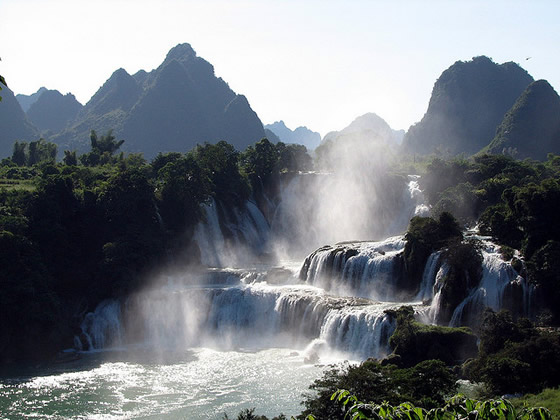
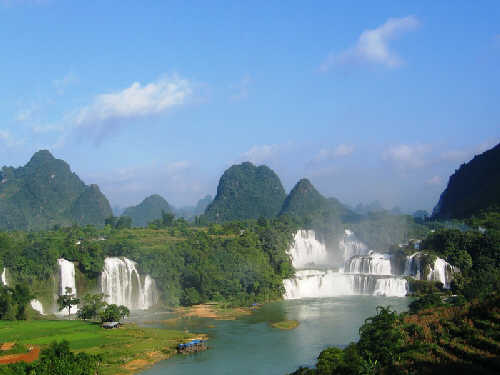
In famous tourists attractions in Cao Bang, Ban Gioc waterfall tourist area is considered as the fourth largest waterfall in the world. It is also the largest natural waterfall in Southeast Asia.

Ban Gioc waterfall, the most beautiful waterfall in Vietnam, is one of invaluable gift of the nature for Cao Bang. It is located in the border of China and Vietnam in Dam Thuy commune, Trung Khanh district that is 89 kilometers from Cao Bang city.

On the way to go to Ban Gioc from the city center, you can contemplate imposing and charming beauty of rivers, streams and forests.

Ban Gioc waterfall lies on Quay Son river rising from China and flowing through communes in Vietnam such as: Ngoc Khe, Phong Nam, Ngoc Con, Dinh PHong, Chi Vien and Dam Thuy. It is 53 meters in height and 300 meters in width.

In the foot of the waterfall, Quay Son river is flat as a mirror, reflecting the clear and blue sky into water. Visitors can hire a bamboo raft to travel around the foot of the waterfall to contemplate its stunning beauty.

Coming to Ban Gioc, tourists have a chance to see Tay people’s houses on stilts.

In order to develop tourism in Ban Gioc, in 2012 December 8th, Saigontourist Company began construction of high-class Ban Gioc Resort with an area of 31 hectares. It will include a hotel with 60 rooms, 24 high-ranking villas, restaurants, entertainment and spa area and areas for camping and outdoor activities.

The project is expected to complete in late 2013. The total expenditure is about 170 billions dong.

In 2013 June 15th, Cao Bang province People’s Committee and Buddhist Sangha of Vietnam began construction of “Phat Tich Truc Lam Ban Gioc pagoda” in Dam Thuy commune. The pagoda is a significant construction to serve people’s need of spirituality and religion in Ban Gioc.

Friday, September 6, 2013

Hua Ma Cave - mysterious place for tourists

Bac Kan is a well-known place as it used to be part of the Viet Bac Revolutionary Zone of the Vietnam Revolutionary Forces and embraces a number of tourist attractions.
Any visitors to Bac Kan could have remarkable feelings about the place and people there. During the resistance war against the French colonists, local people were very bold by having an uprising against the colonisation but now in peacetimes they have become so simple and hospitable. Bac Kan is famous for Ba Be Lake, which consists of three large fantastic lakes surrounded by mountains and forests. Still, there is another mysterious tourist destination, Hua Ma Cave.
Hua Ma Cave is located in Quang Khe Commune, Ba Be District. The cave has only recently been discovered so it is still almost untouched and enigmatic. The cave has been naturally shaped during the many-thousand-year process of geological changes. It is 700 meters in length and in some places the cave opens up and is 50 meters in height. Inside the cave, there are thousands of stalagmites and stalactites of different shapes; some look like small towers, others are like a statue of Goddess of Mercy or a formal court of mandarins in the feudal time.
In fact, Hua Ma has been known by local people for a long time but, as it bears in a myth and a much-weaved occult story, few local people would dare to approach the gate of the cave. The legend tells that a long time ago, a King headed a raiding contingent visited the locality and when he came to the bank of a stream near the cave, his horse stopped and did not go on. The King got off the horse and asked local people about the reason and local people told him that the area was a habitat of ghosts. According to them, when it was getting dark, cries generated from the cave and they decided that these were the spirits of honest people who were killed by foreign enemies during wars.
The King then ordered his troops to erect a pagoda to pray for peace for the souls of the killed people. Since then, local people have not heard the cries from the cave, yet they still consider the cave a holy place that should not be trespassed upon. As a result, the cave has been hidden until recent times.
If the cave is so mysterious inside, the view outside the cave is also great. From the mouth of the cave, people could see a large space, a vast picture of mountains, forests and water. They could see Ba Be Lake and the Nang River running smoothly in distance, they could hear birds singing elsewhere and imposing mountains and forest in front. If lucky enough, visitors could participate in a local monthly market to admire girls and boys of several local ethnic minorities in their traditional colourful dresses and clothes. They could taste and become familiar with local typical specialties and they would get drunk with home-made wine and unconsciously fall in love with the place and people.
Both Hua Ma Cave, the local people and the picturesque locality are waiting for international and domestic tourists to explore them.

BAI HOM - NEGLECTED ISLAND IN KHANH HOA

On a weekend, singer Pham Anh Khoa invited his friend to his hometown for a summer vacation trip. All gathered in a place of Khanh Hoa before joining a boat to come to a neglected island and playing the role of Robinson.

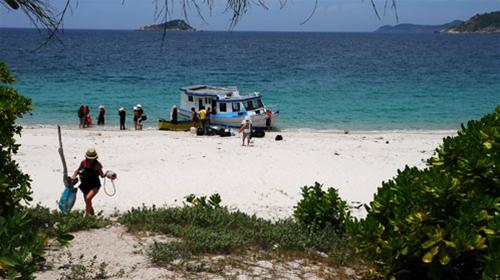
In fact, the destination is Bai Hom – is a 5ha wide valley which is in the middle of stone mountains (50m and 100m high). In order to come here, visitors have to use a coach from Ba Ngoi township (Cam Ranh, Khanh Hoa) to the national road no 1A to Binh Tien (Ninh Thuan) and Binh lap (Cam Lap – Cam Ranh), then taking a 15-minute walk and 20-minute on boat to the island. We also could take the boat from Ba Ngoi port, but it takes longer.
Upon the arrival, everybody settled the tent, food and cooking stuff to the place of striking camp which is right next to the beach. While women were in charge of doing the hammock and the new tent, men takes charge of finding firewood, go fishing or diving to “hunt”. Soon, Mr Bay – a local person – caught a 5-kilogram ray fish, a sliver snapper, a paper amberjack and an eel. Beside the rocky mountain corner, the friend of Anh Khoa caught some cuttlefish, fish out a full pot of sea urchin and sweet snail.


Food for diner has been ready, everybody go swimming or playing football in the smooth white sand bank which is considered most beautiful on the island. The sea is peaceful due to the Binh Ba island blocks the entrance from the East, and the water is pure and limpid to witness the fish on the bottom.
Two other singers dived in the depth of about two meters to see the actinia and coral, holothurians with different colors. All then come to boat to discover the coral range in Rang beach at the back of Hom beach. Debu, a friend from Nepal told that “This is the most desolated and beautiful that I’ve known.”
In the evening, after the meal, people were invited to taste the fresh alive sea food: cuttlefish, fish, sea urchin with the wasabi and lemon. In the mood of tipsy with the heady bouquet of alcohol and the firelight, the real singers as well as the amateur one was singing passionately together with the sea wave. All created a peaceful sound.
In sleeping time, some brought their children to the tent, some lied on the hammock or the canvas. Some followed the local one (Pham) to bury themselves in the sand to avoid wind from the sea and being lulled by the wave. Among the enormous sea and sky, people let them easy in mind with the daily stuffs, they thought they were Robinson in the middle of desolated island but we were with 20 other friends but not only “Friday”!

HIDDEN CHARM OF TO NUNG LAKE

Visiting this sunny and windy land, many mysterious stories are originated from Central Highlands in Vietnam, the opportunity discovers the charming landscapes of this land and also experience the life of ethnic people. Of all the beautiful landscapes, To Nung Lake is a must-see place that you should not miss.

Vietnam’s Central Highlands are the origin of many mysterious stories. Visiting this sunny and winy land, tourists are offered to discover the purified lakes and rivers and vast swathes of old-growth jungle as well as experience the life of ethnic minority group. Of all the charming landscapes of this land, it would be a “big miss” if not mentioning To Nung Lake (T’nung Lake of Bien Ho – Sea Lake) in Bien Ho Commune, approximately 8km from Pleiku city, Gia Lai Province.

Discover the Hidden Charm of To Nung Lake

To Nung Lake used to be the flooded cater of a volcano millions years ago, but now it plays as the reservoir and the tourist attraction of the city. Located in the middle of the red soil land of the highlands, To Nung Lake is well-known for its green clear water and the spectacular surrounding landscapes of lush vegetation and colorful insects. It is regarded as an emerald, the pride of highland Pleiku.
Tourists in Vietnam travel have to pass through a green shade of pine trees before reaching To Nung Lake. Tourists can take a “thuyen doc moc” to discover the hidden charms of the lake, to see the shadows of the pure and sparkling surface of the lake and to jump into the forest to explore the wild nature. Here, tourists have chance to see plenty of diversified flora and fauna. Moreover, ones can participate in some fishing or watching the turtles for pleasure and relaxation.

Discover the Hidden Charm of To Nung Lake

To Nung (T’Nung) is also the name of the village nearby. It is the home of ethnic minorities such as Bana, Gia Rai living in harmony. Those visiting here may go for a stroll around the village to experience the traditional customs and culture of local people. Some are fascinated to stay overnight in the village for camping-fire and enjoying grilled fish drunk with Can wine.
In 1988, To Nung Lake (or Bien Ho) was recognized as a national landscape for its beauty by the Ministry of Culture and Information. The lake has been kept intact with a primitive charm that attracts tourists in Vietnam travel from everywhere.

Wednesday, August 28, 2013

Co To Island

 Located in Co To Island District, Quang Ninh Province, Co To Island is a must-see attraction of Vietnam. In general, Co To Island District is comprised of 40 islands varying in size. Three ofthe largest islands are Co To Island, Thanh Lan Island and Tran Island.


 Co To Island is usually referred to as “Large Co To Island,” which can be explained by its relatively large area. Despite the growth of Vietnam modern industry, the island still has deserted and aesthetic beaches, one of which is Trinh Sat Beach. This beautiful tropical beach has a wonderful shore with white sands and blue, crystal-like water. The sea at Co To seems to be so nice no matter when you look at it: day or night, sunrise or sunset, under the moonlight or in the morning mist. 


Whenever you walk on a Co To beach, you are about to experience manyunforgettable emotions. There is even a romantic path which leads to the lighthouse, the highest peak of Co To Island.  Only 1km long, this path goes within the pine tree forest full of fresh and aromatic wild flowers. When you reach that lighthouse, which is 70 metres above sea level, you can hear the breath of the ocean and fill your mind with the peaceful scenery of Co To. Sometime during harvest time, you can even smell the fragrance of oranges from the nearby Thanh Lan Island, which has turned a splendid. 


The perfect ecotourism tours in the forest of Co To Island are another option to consider when you stay in Co To. Besides, you can actually hire a boat to discover the islands, go fishing or snorkelling (in the company of the boatman, of course!). When you are tired of walking around, sit down and enjoy the incredibly tasty seafood. You can choose to either cook by yourself or to hire a native to cook for a very good price!

Tuan Chau island - A New wonderful island

Tuan Chau island is a new wonderful island with beautiful natural and interesting intertainments, has attracted many domestic and foreigner tourists!

Ha Long, one of the World Heritages, comprises thousands of big and small islands. Each one has its own characteristic with various caves: Sung Sot Cave,Thien Cung Cave, Trinh Nu Cave. Tuan Chau Island is the only soil island of all. It is not only a place having beautiful natural surroundings: pine trees, lakes, beautiful beach…but also where President Ho Chi Minh chose to be the relax place of other State officials' and his when they came here in 1959.
Tuan chau island - A Beautiful island
On the total area of 400 ha, Tuan Chau has the population of 1500. As planned, the total area of Tuan Chau will be widen to 675 ha. It enjoys the advantage of having both road and river transportations. It is about 18 km away from National Highway No.1. This route is an important blood vessel of the robust Hanoi – Hai Phong – Quang Ninh economic triangle. It takes about 3 hours from Mong Cai ( 2 hours by boat) and 1 hour from Hai Phong.
Tuan Chau island’s name is the combination between ‘linh tuan’ (the patrolman) and ‘tri chau’ (district chief) because in the feudal time, the royal army set up a guard station here to patrol and defend the borderland. Prior to 1999, the island's residents suffered from a very modest living standard.There was no power network and no clean water. Roads were only trails and there was no mechanical means of transportation. Tuan Chau was a very poor town where fishing with very rudimentary tools is the only means of living.
The first project of great significance was to link Tuan Chau and the National Highway No18 by building a road. The work was officially started on February 28th, 1998. All company staff had to overcome numerous hardships to achieve this difficult task, which translated people’s dream into reality.
Dolphin & Seal Club

Tuan Chau has become well- known to both international and domestic tourists as an attractive destination with:
- a dolphin&seal club

- a circus
- a crocodile club
- an (artificial) beach with 4 km long. 
- a Vietnamese culinary area
- a hotel and resort area of 5-star standard (200 rooms)
- a water recreation park with activities such as motor racing, canoeing, parachuting, water skiing, etc. 
- Ha Long Bay sight- seeing services by canoe, boat, helicopter.
- a high tech water fountain with music playing, laser lighting and film projecting on water screens.

If tourists in Vietnam Travel have chance to visit Hanoi, Tuan Chau island is a must-see place that should not be missed!

Yen Tu Mountain - Sacred to Vietnam’s millions of Buddhists

Sacred to Vietnam’s millions of Buddhists, Yen Tu Mountain in Quang Ninh Province boasts breathtaking scenery along with hundreds of temples, other man-made structures, and religious objects.

Sacred to Vietnam’s millions of Buddhists, Yen Tu Mountain in Quang Ninh Province boasts breathtaking scenery along with hundreds of temples, other man-made structures, and religious objects.
A Vietnamese saying warns that “Though you practice charity and do good deeds for a hundred years, you will not achieve perfect enlightenment if you have not been to Yen Tu.”
The majestic scenery and the tranquility of its temples inspired King Tran Nhan Tong, who reigned from 1279 to 1293, to pass the throne to his son and lead the life of a Buddhist monk at Yen Tu.
There, he founded the first Vietnamese School of Zen Buddhism: Truc Lam.
The sect soon attracted thousands of followers so Tran Nhan Tong ordered the construction of hundreds of buildings and other structures on Yen Tu Mountain.
His successor, Phap Loa Dong Kien Cuong (1284-1330) maintained the pace of construction and Yen Tu remained the country’s leading Buddhist center through the Le and Nguyen dynasties.
Religious devotion
At an altitude of 1,068 meters, the summit of Yen Tu Mountain is covered by clouds most of the time.
Until early last year, religious devotees and adventurous tourists had to trek through six kilometers of dense bamboo and pine to reach the top. Now there’s a cable car.
The ease of the high-wire trip to the summit goes down poorly with Minh Ha from Hai Phong, who reckons a true Buddhist should ascend the peak on foot so as to show sincerity and be suitably rewarded.
“Many people claim that it’s difficult to reach the peak of Yen Tu Mountain by foot, yet hundreds of elderly people manage it,” says Ha pointedly.
Nguyet, 58, heartily endorses the idea of trekking to the summit. “I have never felt so alive and excited as when I climbed to the top one step at a time,” she exclaims in delight.
Rock at Heaven’s Gate
The best-known feature of Yen Tu Mountain is the rocky outcrop called An Ky Sinh, which stands two meters tall on the summit and is aptly known as Heaven’s Gate.
It is named after the legendary Chinese Taoist An Ky Sinh, who dwelt on the summit of Yen Tu thousands of years ago and turned to stone after achieving enlightenment, or so the story goes.
Some of the thousands of pilgrims who flock to Yen Tu every year, especially for the spring festival, rub money on the rock in the belief that it will bring financial prosperity and help them run their business better.
It’s one of several important rocks on the mountain. Another juts out over a small and often crowded temple in the grounds of Hoa Yen-Mot Mai-Dong Pagoda down below.
Temple on the mount
Situated at 1,000 meters above sea level near the rock of An Ky Sinh, Dong (copper) Pagoda is usually cloaked in mist and cloud cover, but when it clears the whole panorama of Vietnam’s northeast is laid out in detail.
From a short distance away, the pagoda resembles a golden lotus. It was recently rebuilt at a cost of more than VND21billion (US$1.23 million).
The entire structure with more than 3,500 statues, bells and such weighs some 70 tons, so building the temple and fitting it was quite a feat.
Back to earth
Back down in Truc Lam Zen Monastery at the foot of Yen Tu Mountain, the head monk gives public lectures on the history of Buddhism and the lessons it teaches. There is also a vegetarian restaurant called Nang Tam open to everyone.
The access road is named Vang Danh and starts in Thuong Yen Cong Commune, Uong Bi District 125 kilometers from Hanoi and 50 kilometers from Ha Long by the famous bay of the same name.
If tourists in Vietnam Travel have chance to visit Quang Ninh Province, Yen Tu Mountain is a must-see place that should not be missed!

A perfect summer in Quang Ninh

Mentioning Quang Ninh, everybody often think about Ha Long Bay with thousands of limestone karsts and isles in various sizes and shapes, and stunning caves, etc.
Ha Long Bay

Ha Long Bay has an area of 1,553 square kilometers, including 1,969 isles, most of which are limestone. The world heritage site recognized by UNESCO has an area of 434 square kilometers, including 788 isles with a special value on culture, aesthetics, geology, biology, and economy.

On the bay, there are many isles, caves, beaches and beautiful landscapes, which is a great advantage to develop attractive forms of tourism. The most attractive caves are Thien Cung, Dau Go, Sung Sot, Trinh Nu, Tam Cung, etc.

Bai Chay

Bai Chay is a large and beautiful beach being adjacent to Ha Long Bay. Its sand is more than 500 meters in length and 100 meters in width. In the early morning or late afternoon, thousands of people come here to swim, which make the beach animated.

There are many legends associated with the name Bai Chay. According to an ancient legend, when the fleet carrying food for the Yuan-Mongolian invaders led by Truong Van Ho came Vietnam, they was defeated by the Vietnamese troops and local people under the leadership of Tran Khanh Du. Many enemy boats were burned and the northeast wind blew the fire to the west coast of Cua Luc then burned dry forests there. The area is called Bai Chay today.

Yen Tu Mountain

Yen Tu Mountain is a high mountain in Dong Trieu range in the northern Vietnam. The moutain belongs to Thuong Yen Cong commune, Uong Bi city, Quang Ninh province. Being dubbed “ancestral land of Vietnam Buddhism”, Yen Tu moutain preserves many historic monuments.

The top of the mountain is often covered with clouds so formerly, it was called Bach Van mountain (“white cloud” mountain). The total length of the road to the top of Mountain is about 6,000 meters. Therefore, you will have to spend 6 hours walking continuously through thousands of stone steps.

Nowadays, the way to Yen Tu is not as hard as it was thanks to the cable car system 1 completed in 2002 and th cable car system 2 put into operation in 2008.

Yen Tu has become the center of Buddhism since King Tran Nhan Tong gave up the throne to started leading a religious life and established Truc Lam Yen Tu Zen. King Tran Nhan Tong has become the first progenitor with the religious name Dieu Ngu Giac Hoang Tran Nhan Tong (1258-1308).

He ordered building hundreds of constructions on Yen Tu Mountain for leading a religious life, and preaching. After his death, Phap Loa Dong Kien Cuong (1284 - 1330) was the second progenitor of Truc Lam Zen.

During 19 years of religious life, Tran Nhan Tong compiled a set of book "Thach that ngon ngu" and ordered the building of 800 pagodas, shrines and towers with thousands of valuable statues.

Tuan Chau island
Tuan Chau island is located in the southwest of Ha Long City. Tuan Chau Island is the only schist island of 1,969 islands located in the connection of the world natural heritage. The island has an area of approximately 400 hectares, endowded with stunning natural landscapes.

It's featured with 2-square kilometer green pine forest, white sand beach stretching 6 kilometers. These all features make Tuan Chau Island an ideal place for visiting and relaxing.

Besides the attractive and mysterious beauty of natural landscapes, Tuan Chua is also anarchaeological site of Halong Cultures in late-Neolithic period with a lot of stone tools found such as ware table, stone axes, piece of pottery.

Before 1997,  Tuan Chau was a poor island with an area of 250 hectares, belonging to Ha Long city. The local people on the island mainly earn their living by fishing with rudimental instrumments. There were no electricity, no water, no market on the island.

Especially the traffic was separated from the mainland, making their material and spiritual culture of the local peoples on this island had even more difficulties.

Since 1998, the local people’s lives on Tuan Chau island began to improve when Au Lac Company invested to build a road with the length of 2,145 meters and the width of 15 meters connecting the island with the National Highway 18A, opened a leisure center with many famous constructions. Since then, the name of Dao Tuan Chau Island has been known and became the place to oganize the important national and international events.

Tourists can play on famous Tra Co beach sloping gently to the sea with smooth white sand. In addition, they can take part in a lot of funny activities and water sports such as beach volleyball, windsurfing, boating, skiing motor, etc.

Especially, tourists will have a chance to enjoy delicious dishes in Vietnam cuisine garden. The garden was built in unique style, imitating the traditional Vietnamese imperial palace architecture in 17th and 18th century.

Co To island
Co To island attracts tourists by pristine beaches with white sand and blue water. There are large Co To island and small Co To island, Thanh Lam island, Tran island and a lot of other isles here. Besides swimming, tourists can visit natural forest, lighthouse, pier, fishing villages, and natural rock, etc.

Cua Van fishing village

Cua Van fishing village lies in a calm sea, surrounded by mountains.Located in the heart of Ha Long Bay, Cua Van fishing village has been a tourist attraction for domestic and foreign tourists.

Coming to the village, touists have a chance to contemplate immersed in a tranquil space and contemplate charming beauty of nature, as well as learn about cultural life of fishmen.

Cua Van fishing village has an origin from two old fishing villages which are Giang Vo and Truc Vong. The village has 176 families, totaling more than 750 people. Most of them earn their living by fishing.

When the night falls, visitors can go sailing around the village and go fishing for squid with fishmen.

Wednesday, July 31, 2013

Stunning journey to Thung Nai, Hoa Binh

If you have ever been to Thung Nai, Hoa Binh, it makes no surprise that you will be enchanted by the charming beauty that is considerd as Ha Long Bay on land.
Thung Nai is a commune in Cao Phong district, being nearly 25 kilometers from Hoa Binh city. In recent years, tt has been a new tourist destination in the northern Vietnam.
Explaining the name “Thung Nai”, the local people said that in the past, Thung Nai was a great valley covered by the vast forest, which is home to numerous deer. Therefore, “Thung Nai” means “ the Valley of Deer”.
Since the 1980s, Thung Nai has become a big lake to contain water severed for the operation of the hydropower plant on Da River when this hydropower plant was constructed. All initial surrounding high mountains become floating green islands and create poetic and magnificent scenery which can enchant every tourist coming here.
The best time to visit Thung Nai in the autumn, when the water level reaches the highest and the valley is filled with the romantic lake water. 
Coming here, visitors can visit intriguing islands as Lan island, Qua island, Ngoi Hoa cave,  Thac Bo cave, Trach stream.  Here, visitors can bath in cool water. On the other hand, if you want to learn the life of Muong people, you can visit Mu or Gia Mo village in the valley.
As many people, after visiting popular destinations here, we stopped at Thac Bo Cave- a national heritage.

Thac Bo cave
Thac Bo is a deep cave separated by many levels. Behind the high and large entrance, visitors see multi-shaped stalactites mirrored on a limpid pond and listen to the stone musical instruments and gongs of the Muong ethnic group.
The heritage is located next to the imposing Da River and Bo temple, a popular tourist destination and pilgrimage. Here, visitors will have an opportunity to admire spectacular stalactites like ice cream in Thac Bo cave.
Try to visit Thung Nai once in your life, tourists can enjoy the beauty of wild nature and witness the life of ethnic minority people living on the mountainous areas. Thung Nai promises to bring great tourism potential to Hoa Binh Province in the near future.

Friday, July 26, 2013

An Bang, Bai Dai listed among world’s 100 best beaches

An Bang beach in Hoi An and Bai Dai (Long Beach) in Phu Quoc were placed 86th and 93rd on the list of the 100 best beaches in the world, as announced recently by CNN Travel News.

An Bang beach
Phu Quoc is fast becoming Vietnam's most popular new island destination,” it reported.

Visitors to the island can learn about its traditional local trades, including making fish sauce, planting peppers and breeding oysters for pearls.

Located in the western part of the island, Bai Dai has a 15km long beach with crystal clear water. It was also introduced by Australia’s ABC News in 2008 as one of the most beautiful, cleanest and unspoiled beaches in the world.

An Bang, which lies 3km away from the famous ancient town of Hoi An, is described as having “gentle waves and soft, white sand”. Its “Western-managed bars and restaurants” as well as its “specialized Viet cuisine restaurants” attract large numbers of foreign tourists.

In 2001, it was among the top 50 beaches in the world as selected by CNN Go.

Wednesday, July 17, 2013

7 Reasons you should visit Binh Ba island

Binh Ba island located in Cam Ranh City (Khanh Hoa Province), is famous for the name “ lobster island” with island’s richness.. Here are 7 reasons you should visit to Binh Ba island when setting foot in vietnam.
In addition, Binh Ba has been gradually developed into popular tourist sight. If you have never been to Binh Ba, here are 7 reasons you should visit here.
1. Convenient Transportation
Binh Ba island is 15 km far from Cam Ranh. It takes you more 1 hour of sailing to get there from Da Bac Port. Every day, there are 2 boat trips from Cam Ranh to Binh Ba: one is from 10 am to 4 pm, and from Binh Ba to Cam Ranh is from 5 am to 12:30 pm. Each costs 15-20.000VND.
2. Crystal-clear and blue water
Because this is pristine island, so there are many beautiful beaches with white sand, clear water, blue sky…In particular, this is suitable for those who love nature and calmness.
People here are very aware of protecting the environment, beaches..
3. Uncrowded beach
There are few visitors coming here. There are about 700 households with 5000 people. Coming here, you will not worry about cramping
4. Watching sunrise
There are 3 famous beaches in Binh Ba as Bai Chuong beach, Bai Nom beach, and Nha Cu beach. Each one has its own characteristic for visitors to explore. If Bai Chuong is a place to watch sunrise, Bai Nom is also an ideal place to camp and watch dawn in Bai Nom. Nha Cu beach is also loved by many visitors coming here to scuba dive.
5. Friendly people
The local people hold tourist services in Binh Ba Island. Tourist services include accommodation, boat rent…Local people are very friendly and hospitable.
6. Fresh seafood
In the early morning, you can follow the instruction to market to buy fresh seafood and local people will process for you. Squid is sweet and thick. It is so delicious
7. Wearing life jackets to enjoy dinner on the sea
Have you ever enjoyed your meal when floating on the beach. Coming to Binh Ba, visitors will wear life jacket, float on the beach and enjoy your meal.