Wednesday, November 14, 2012

Hanoi museum


Among some famous sites such as Sword Lake, 36 Old Streets, Van Mieu-Quoc Tu Giam (Temple of Literature), etc. Perhaps Hanoi Museum is beautiful place that shouldn’t miss for tourists who want to explore Hanoi through the length of thousands years of Vietnam history.
Located on Pham Hung Street, next to the Vietnam National Convention Center, Hanoi Museum - one of the important workarts of the great festival inaugurated 1000 years of Thang Long - Hanoi - is where presents the past and present of Vietnam with thousands of artifacts related to the capital, thousands of years of civilization.
With more than 50.000m2 area, this is a largest and modernest museum in the country. From a distance, Hanoi Museum, impressed by the unique architectural design, was conceived as an inverted pyramid.
The museum has six floors, including four floating floors and two basements, the floor area gradually scaled down from top to bottom.
 Visitors can reach the upper levels by elevator or by stairs are designed into a spiral ramp.
spiral stairs
The first floor area was designed as a temporary place to display some of the pottery shops selling souvenirs.
The second floor is a small collection with Hanoi natural areas,  Phung Nguyen grave, boat graves, the Dong Son culture and other pictures of Hanoi.
Dried leaf samples and photographs of every crocodiles that went into painting poetic music. Sample of dried flowers, leaves, milk flowers - sexy flowers are passionate about an immense Hanoi's autumn or suggestions about beautiful melody in songs. In addition, West Lake shrimp samples, fish samples associated with known famous specialties of Hanoi  - La Vong fried fish, West Lake shrimp cakes. .
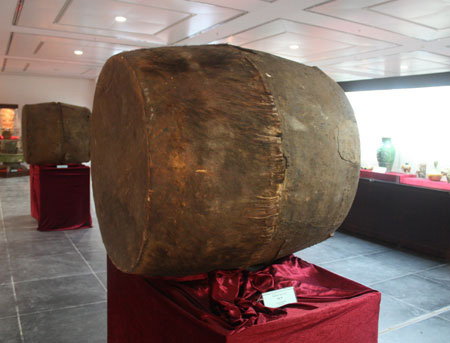
The museum displays many ceramics in different periods of the history.
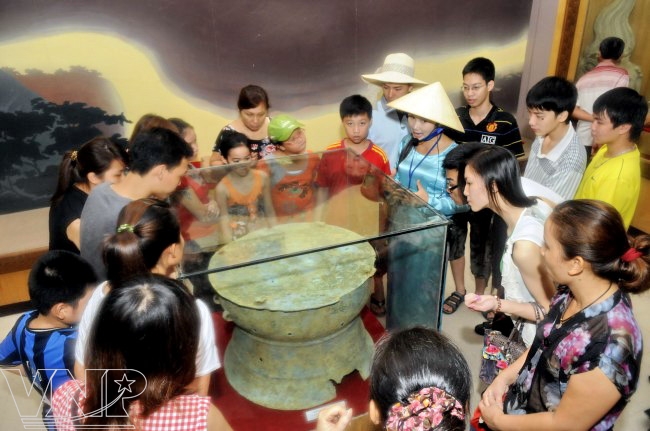
Dong Son bronze drum - a cultural symbol of Vietnamese people

Sáng nay khánh thành Bảo tàng Hà Nội, Tin tức trong ngày, bảo tàng Hà Nội, Đại lễ, 1.000 năm Thăng Long Hà Nội, tượng phật bà, cổ vật, di sản văn hóa, kim tự tháp ngược
A corner of Hanoi museum
Visiting Hanoi museum, tourists will have the opportunity to admire the antique things collected from around the country.
Let's up the third floor of the museum - the collection of space artifacts show artists' heart with their love for the capital- where displays documents and exhibits by organizations and individuals to donate, etc.
The fourth floor contains conference rooms, research rooms, offices and the library. With a lot of pottery such as bowls, vases ... or production tools, canoe found in Tien Giang and Ca Mau are on displayed on this floor.

Sunday, November 11, 2012

An original art of Vietnam


According to scholars specializing in portraying art, lacquer plays the first role in traditional materials in Vietnam's painting background. Opening to the world, Vietnam's lacquer paintings have got special attention because of its distinct nuance that strongly expresses national characters.
 Yes, lacquer art has a centuries-old tradition in Vietnam, having first been introduced by the Chinese in the making of handicrafts and decorative items. In previous centuries, wooden statues in village's communal houses, temples, pagodas were red-lacquered and trimmed with gold. Altars, parallel sentences panels, and horizontal lacquered boards were handled by lacquering with sparkling colors.
Why was lacquer painting considered as an original art of Vietnam?
After the establishment of the Ecole des Beaux Arts de l’Indochine by the French in 1925, however, that anonymous craft performance became a new art form and was applied to paintings for the first time. At that time, the founders of the Ecole, Victor Tardieu and Joseph Inguimberty, recognized the beauty of the Vietnamese artistic traditions and wanted to help their students make the most of their heritage as well as teaching them Western painting. During the 20 years of its operation, the Ecole trained more than 100 Vietnamese artists who would become the pioneers of Vietnamese modern art, combining indigenous art forms with the art of Manet, Degas, Monet, Pissarro and Renoir. The 1930s was the time when lacquer paintings and other works of fine arts confronted a great renaissance. It confirmed that the ability to express ideas and feelings of lacquer paintings is unlimited.
The lacquer and colors
Lacquer is a clear sap coming from of six species of trees growing in the North and the South Vietnam, both belonging to the familyAnacardiaceae. Lacquer - a harmless substance - is harvested in the same way as rubber by making an incision and letting the sap flow. Fresh lacquer is whitish and turns brown upon exposure to air. Black lacquer stems from a chemical reaction between lacquer and iron, then, it will be mixed with various natural or artificial dyes to produce the favorable colors. Surprisingly, several shades of red are extracted from a naturally occurring red mineral, cinnabar (mercuric sulfide). White is produced from eggshell. Eggs from ducks are used because they have a better structure than hens’ eggs. The eggshells are cleaned and sometimes even burned to obtain a brownish tinge.
Several other materials may be used to make lacquer paintings; the most common are gold leaf and silver leaf. Silver is used below the layers of colors to create an effect of immense luster. Gold leaf, on the other hand, is often applied as the final layer. An interesting use of gold leaf will make it appear as bright light flowing through the window. Besides, a range of other materials may also be used, such as shells, sand, epoxy and clay.
 Applying colors and polishing
 Painting with lacquer is a long and complex process requiring great skill and patience. It may take several months, depending on the specific technique of the artist and how many layers of lacquer are included. It involves the application of many layers of lacquer on a prepared wooden board, allowing each to dry in turn, and finally polishing the painting with pumice to reveal whatever colors the artist desires in different areas of the painting. Other materials used include eggshell to produce a white color, mother-of-pearl, gold and silver leaf. The final result is smooth and durable and will not crack due to fluctuations of temperature or humidity.
However, paintings after finishing need more time to be touched. It may be months, years, even plenty of years. The painters have to whet again and again their paintings to make them flat. Paints are drawn in many layers then can bring beautiful, occult and splendid colors. If you take notice, you can realize the capabilities and preeminence of different ones. Black lacquer is shiny, glossy and profoundly mysterious while cockroach-wing lacquer is lissome and limpid. Covering golden or silver color, the other colors can change to create derivative color bringing theatrical timbre. By coordinating ages of different-aged colors, color powders also become vaporous and radiant to finally make up sunk and floated parts of the paintings.

Many lacquer paintings and art objects of Vietnam have been brought overseas in mass. Painters, much or little, often draw lacquer paintings by sudden inspiration and following their flow of emotions. Vibration in their heart is reflected through the work without any rules or formulas. Because of those factors, the spirit in Vietnam's paintings turns to be profound.
There are some painters who have strong attachment with lacquer and have published resounding paintings such as Nguyen Sang with his work "Afternoon rest"; Tran Van Can with "Miss Thuy"; Phan Ke An with the painting "Missing one evening in North west"; To Ngoc Van and "Spending the night on roadside"; Mai Van Nam with "Going to Bac Ha market"; Nguyen Van Ty with "Thatched cottage and foot of jackfruit"; Tran Đinh Tho and "Bamboo"; and Nguyen Gia Tri with "Spring Garden", "Bailing water to prevent blood", and "The girl at hibiscus mutabilis  flower".
In Vietnamese art treasure, besides lacquer paintings, there are many kinds of traditional paintings such as Dong Ho glazed paper paintings, oil-paintings, silk paintings.... Each type has its own special features that make Vietnamese people always feel proud when mentioning them with foreign friends from all over the world.

Stork island in Chi Lăng Nam

The stork island is located in Chi Lăng Nam commune, Thanh Miện district and stays about 25km far from Hải Dương city. Its pen name is An Dương by nature. It is called the stork village because the village has a small island located in the middle of broad lake with ten thousands of storks and herons residing and nesting. With an area of more than 3,000m2, the stork island is home to 15,000 storks and more than 5,000 herons of various kinds and such rare and precious birds as pelicans and teals residing together. 
Photo: Đức Linh
Located in the middle of vast lake, the stork island emerges as a pearl endowed by the nature for Chi Lăng Nam. The local residents still tell each other the legend for this land. It is said that at the beginning of the 15th century, deluges broke the large dyke along the Red River for three consecutive times. At the second breakage, an island emerged in the middle of the lake. Then, "birds perch good land", each herd of storks, herons and water birds come here from everywhere. With the time, storks and herons residing in the island are more and more crowded in the quantity and diversified in species.
From September to April every year, most storks can be seen with up to ten thousands of storks and thousands of herons perching in close proximity to one another on the bamboo tops and tree branches like flowers filled with white cotton from a remote view. They get together to nest, lay eggs and nurse their babies. The tourists are more excited to see young storks with immature legs on soft bamboo branches. When the sunset is let down, the storks return home. They fly into herds, each herd including 50 to 70 storks, even hundreds of storks creating true white curtains on the trees in the island. After flying for many times covering the whole lake space, they land safely on the green clump of trees in the middle of vast sea in the glow of sunset. It is followed by spans of the herons pending search for food at night. The tourists will witness an interesting "chorus" of families of storks and herons. The stork island is excited with sound like a natural chorus tearing a quite atmosphere of a Vietnamese village.
Tourists who come to the stork island in the season need only one day to visit the whole island. A small boat that is arranged so as not to disturb living environment of the storks will slowly take the tourists around the lake and see the life of storks. However, if the tourists expect to watch the live of storks more carefully, please stay overnight on the stork island. From 9.00 to 10.00, the storks come back most. The family reunion also starts from this time to the next morning. At that time, the tourists will have more time to study the life of storks on the island.
The harmonious intercalation between trees, birds and lake together with fresh, ventilated tropical weather as well as such historical and cultural monuments as temples, pagodas and traditional trade villages such as fish nursery, rice pancake, decorative plant, Chi Lăng Nam has full factors to become a typical ecological tourist area for the North Vietnam village. Hải Dương Tourism has made the tour on Chi LăngNam stork island a new tourist product of the province.

Thursday, November 8, 2012

Dak Nong's weather is cool year-round


The climate is relatively temperate regions, the annual temperature is 24 ° C, the hottest and coldest average difference of only 5 º C.
Dak Nong Province, Vietnam, is located in the southwest of Central region with the average height of 500m above sea level. Topographically, it is relatively flat, a immense plateau with pastures stretching to the east. Lower terrain to the west, and the south is the domain of many low-lying lakes. 

 Trinh Nu Waterfall

The climate is relatively temperate regions, with the annual temperature is 24°C, the hottest and coldest average difference of only 5ºC. 
Dak Nong is suitable for visitors who love the majestic waterfall landscape, camp-fire night, the sound of gongs and the taste of the wine. Serepok River created many beautiful waterfalls, as benevolent as violent; Gia Long waterfall as a woman sleeping in wild and romantic and Dray Nur waterfall as a huge wall. Moreover, there are also many other majestic waterfalls, including Dieu Thanh waterfall, Ba Tang and Dray Sap waterfall known as Smoky waterfall.

Hon Mau island in Kien Giang

About 90km far from shore, Hòn Mấu is one of the twenty one small, beautiful and ideal islands in Nam Du archipelago (Kiên Hải district, Kiên Giang). Hòn Mấu is about 200ha wide with more than 120 households living nearby. Most of the island residents live on fishery and are very friendly and hospitable. 
The nature has endowed Hòn Mấu with beautiful landscapes, 5 beaches on the island including 2 beaches Chướng and Nam with fine white sand that can be compared by any other places and three rocky beaches: Bắc, Đá Đen (Black Rock) and Đá Trắng (White Rock). Nambeach is the frontage of the island with almost smooth sea all the year round, thus the ships that come to do business stop here. This beach is also very clean.
The most interesting hobby is to wallow in cool water in Chướng beach. Such beach is like a huge water lake, surrounded by coconut rows and stretching sand banks, transparent turquoise water. Even you walk away for tens of meters, you will see the bottom. It is close to two rocky beaches with many beautiful rocks. Most of them are shiny black, so they are called Black Rocky Beach. Rocks in this beach are diversified in shapes and colors. When the sun darts its beams, rock under the sea is sparkling with many spectacular colors. Some rocks have quite strange patterns. Rock veins are tortuous in blue and red like marble veins. From Black Rocky Beach, you will reach WhiteRocky Beach after walking for around 15 minutes. The whole beach is filled only with white rocks. Rocks which are as small as fingers or as big as hands lie along the beach. This beach almost has no sand. Tourists coming to these rocky beaches wish to take some rocks as a gift of the sea.
According to Vietnam Institute of Geology and Minerals Research, Nam Du archipelago is structured by two formations. For rocky formation under fetsic volcanic system alone, it includes tufryolit and ryolit. At big cliffs, it is easy for tourists to image eruption of lava when forming these islands. Rocks are not slates with smooth surface but very rough and rapid like flowing lava of the volcano. Each rock fall bears its own feature to create strange-looking shapes, difficult but imposing positions in front of the sea.
Spending overnight in Hòn Mấu, tourists can feel the sea breath. After 11.00 pm, power generator stops working, the life on the island come back to the inherent deserted nature. Tourists have chance to sit next to the islanders by tea cups or sip rice alcohol with fish and snail caught from the sea while listening to sensational stories of Nam Du archipelago and Hòn Mấu.

Monday, November 5, 2012

Lam Kinh - A well-known historic relic

Lam Kinh is located in Xuan Lam Commune, Tho Xuan District, Thanh Hoa Province. It is 50km from Thanh Hoa City towards the Northwest. Here, tourists have a chance to visit a well-known historic relic related to the life and career of King Le Thai To, a famous king in Vietnamese history, and the uprising of the Lam Son troops in the 15th century.
After ten years of leading the Lam Son uprising to fight against the Northern invaders, Le Loi won and became a king in 1428 with the official name of Le Thai To. He set up the capital in Dong Kinh (Thang Long – present-day Hanoi). Simultaneously, he ordered an imperial city built in his birthplace and called it Lam Kinh or Tay Kinh.
According to historical documents and evidence found in the excavations in the area, the imperial city of Lam Kinh was built on a large-scale with the architectural style of “Noi cong, ngoai quoc” (the internal shape looks like the Chinese character “gong” and the external shape looks like the Chinese character “quo”). It includes magnificent buildings like a palace, a southern gate, an imperial temple and a dragon yard. The imperial city sits on Dau Mountain in the north and faces towards the Chu River in the south. In front of it is Chua Mountain, on the left is Phu Lam Forest and on the right is Huong Mountain.
After five centuries, most of the structures in Lam Kinh were ruined and now there remain only four imperial tombs of kings from the Le Dynasty and the tomb of Queen Ngo Thi Ngoc Giao, mother of King Le Thanh Tong. In 1962, Lam Kinh Historical Relic was recognized as a national historic relic by the State. In 1994, the Government approved a project to restore 50 of the structures, including the citadel, the Ngoc River, an ancient well, a triumphal arch, the southern gate, imperial temples, the palace and imperial tombs. With these valuable historical structures, the relic has become a famous tourist destination in Thanh Hoa Province.
To reach the central area of the royal citadel, visitors pass over a stone bridge crossing the Ngoc River. Walking for about 50m, tourists see a green plot of grass and an ancient well with clean and clear water. Next is the southern gate with a 300-year-old banyan tree covering up the roof of the gate and then a dragon yard. Passing the dragon yard, tourists come to the central palace where kings gave audience and discussed state affairs.

The central palace includes three large wood buildings which had great architectural value in the Le So Dynasty (1428-1527). Behind the central palace are nine imperial temples that were successfully restored.
From the central area of the royal citadel, on the roads paved with red bricks to forests tourists visit the tombs of kings in the Le Dynasty under green leaf canopies or climb up to the windy Dau Mountain and enjoy Tay Lake with its wild and poetic beauty. 
Visiting the relics on August 22 of the lunar calendar, tourists not only enjoy a beautiful landscape and learn about the culture, architecture and history of this land but also participate in the Lam Kinh Festival with many traditional folk games. The festival is annually held on King Le Thai To’s death anniversary to commemorate his glorious achievements.


In the exhibition room at Lam Kinh Relic Site. Photo: Tran Thanh Giang

The best time for traveling to Nha Trang

The best time for traveling to Nha Trang would probably be March or April. The least windy months of the year are May, April and June. In general Nha Trang is not windy ennough to windsurf, with the exception of Doc Lep beach ( 35 km north of Nha Trang), which is usually reserved for experts.

The weather in Nha Trang is warm and comfortable anytime during the year can be favorable for a trip to the tourism city. In summer often lasts from May with sunlight and hot weather, suitable for natural tourism such as ecotourism, ocean tourism or water sports; while the other months could be pleasing for tourists to visit cultural and historical places such as Ponagar Temple Tower, Vinpearl or The Nha Trang Aquarium.
While most of the South of Vietnam is turned into water for half of a year by monsoon winds, Nha Trang experiences only four “wet months”, from September till mid-December, which are also a time to reconsider visiting Nha Trang. In the first eight months of the year, this coastal city enjoys a warm and beautiful weather and so any day between January and August is good time to start your holiday in Nha Trang.
Though long dry season gives beach lovers a big time budget to enjoy the sun-sea-sand in the area, tourists are advised to visit here before the late of June to avoid high humidity and tropical heat in two hottest months of the year (July and August).
The best time to visit Nha Trang would be from February till April, when temperature is kept around 26-27 degree Celsius, and precipitation stay at the lowest level of the year. Spring months are also the best time to dive here. Some coral-rich dive sites that diving enthusiasts should not miss out on are Small Hill, South Reef, and Moray Beach After, all around Mun Island.
If your trip is scheduled for July or August, remember to give Hòn Bà (30 km far from city center) the first position on your tourist attraction list. The mountain with cool climate all year round is absolutely a great place to hide from the summer heat.
Autumn travel in Nha Trang is not recommended. Though it is not cold, rainy, tropical storm and typhoon may annoy most of tourists. Visitors in Vietnam tourism planning to visit the area from September till December should keep your eyes on the local weather forecast.