Tuesday, December 25, 2012

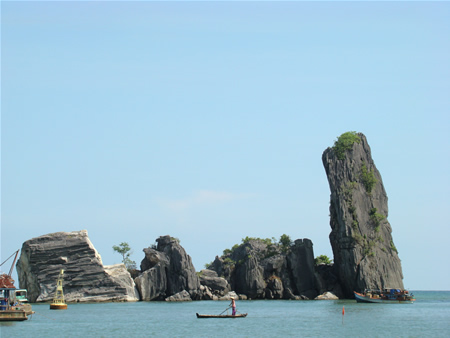
Phu Tu islet - a beautiful natural sculpture rocks


Situated in Kien Luong district, Kien Giang province, Phu Tu Islet is considered as a symbol of Ha Tien. The Islet, which lies more than 100m offshore, is a beautiful natural sculpture of rocks.

Phu Tu Islet, which lies more than 100m offshore, is considered to be a symbol of Ha Tien, Kien Luong district, Kien Giang province, Vietnam travel news reported. Tourists come there often don’t forget to take a picture to remember their trip to Ha Tien, a captivating land.


For tourists in Vietnam travel coming to Ha Tien, it is a magnet. Phu Tu Islet is a beautiful natural sculpture of rocks. It is known in English as the Father and Son rocks and they are seen about a hundred meters from the shore of Ha Tien.

Phu Tu Islet does offer a great view even though it is not the biggest attraction here. It is also a great place to take a postcard picture to remember your trip to Ha Tien.

Friday, December 21, 2012

Travel to Vietnam and enjoy Tom Long in Mekong River Delta

Tom long is a favourite food of the Mekong’s delicacy, a kind of small crayfish the size of a thumb, and is expensive for its size but worth every dong.


Tom long (Vietnamese: Tôm lóng) is a favourite food of the Mekong’s delicacy, a kind of small crayfish the size of a thumb, and is expensive for its size but worth every dong.
Mekong River Delta is famous for water culture, have many dissever kinds of fishs, crafts, shrims as well as other special product. This is one of the most attractive destinations in Vietnam travel.
Tom long lives in canals and waterways or along the banks of Tien and Hau rivers. The local farmers usually put bung, a tool to catch this shrimp, in the area with strong flows of water. The crayfish can even be raised in paddy-fields or small ponds.
To cook “tom long nau bong so dua” (Tôm lóng nấu bông so đũa), you need a half kilo of fresh catches. First, you need to wash them, cut their feelers and leave the shrimps in a basket until they dry.
The next step is to cook a pot of water, wait until it boils and add some salt. Then you need to mince some lemon grass, red pepper and merge it all into hot water.
After that, you put some sugar, monosodium glutamate, fish sauce, tomatoes, pineapple, and tamarind into the pot. The dish will be even tastier if you add some con me.
A half kilo of flowers of so dua should be prepared for the next step. When the water boils, you have to put tom long into the pot first.
When the shrimps turn red, put so dua flowers into the pot and turn off the cooker. What you have to do now is to add some flavor with mu om vegetables.
Enjoy the dish with hot cooked rice or bun (soft noodles), and dipping one shrimp into delicious fish sauce or a combination of salt and red pepper surely makes for a beautiful taste. The season to taste tom long is from January until the rainy season arrives.
You can find many tom long dishes in several restaurants in Mekong Delta provinces, including tom luoc nuoc dua (shrimps boiled with coconut milk), tom chien bot (shrimps fried with flour), tom tron goi ngo sen (shrimps mixed with lotus rootstock) etc. However, the most simple and attractive one is still tom long nau bong so dua.
This is such a special delicious food that tourists in Vietnam travel to Mekong River Delta should not miss.

Tuesday, December 18, 2012

Dong Hoi Citadel Symbolizes the brave of Vietnam

In the past, Dong Hoi Citadel held an important position in many periods of Vietnam history. Today, there is no more war in Vietnam, but the beautiful Dong Hoi citadel still stands vividly as an honorable symbol of the brave country.
Dong Hoi Citadel is located in Dong Hoi city, Quang Binh Province. It is a complex of high fences and towers, forming a fortress that protected the kings and the capital of the Nguyen dynasty since 1630. The citadel is 1'500 m away from Nhat Le beach; it is adjacent to Nhat Le River in the East side and the forest on the West side.
Dong Hoi Citadel symbolizes the brave of Vietnam
The construction of Dong Hoi Citadel was started in 1812, at the location where King Nguyen Phuc Nguyen built Tran Ninh Rampart and Dong Hai Post in 1774. When King Gia Long passed away, King Minh Mang asked a French general to re-design the citadel, and in 1824 he rebuilt it into an invincible fortress which has the shape of a star. The perimeter of the citadel is 1.860m; its height is 4m. The 1.35m-wide façade faces the West. In addition, the citadel has 3 other big gates: North, South and East, which are equipped with 8-roof towers. Each gate has a well-designed bridge which connects the citadel with the outside area. In 1842, when Kinh Thien Tri was reigning, he renovated Dong Hoi citadel to consolidate its strength.
Dong Hoi citadel held an important position in many periods of the country's history. In 1885, when the French army attacked it, people and the soldiers of Dong Ha defended and triumphantly won the battle, making the French retreat. During the Vietnam-France war from 1945 to 1954, the local inhabitants have also made several attacks at the citadel.
Nowadays, there is no more war in Vietnam, but the beautiful Dong Hoi citadel still stand vividly as a honorable symbol of the brave country, attracting tourists who travel to Vietnam.

Monday, December 17, 2012

Landscapes Don't Miss in Vietnam


From the island-studded seas of the north to the meandering waterways of the south, Vietnam is a country defined by the diversity of its land and the resilience and generosity of its people. Lonely Planet Traveller magazine shows you how to take the perfect trip to Vietnam.

Halong cruises Bay: best for coast

The mystical landscape of Halong Bay, where over 2000 limestone islets rise from the Gulf of Tonkin. Photo by Matt Munro
Once upon a time, a friendly dragon lived in the heavens above Halong Bay. With invaders from the seas threatening Vietnam, the gods asked the dragon to create a natural barrier to protect its people, Vietnam travel news. The dragon kindly obliged, performing a spectacular crash landing along the coast – digging up chunks of rock with its flailing tail and spitting out pearls – before grinding to a halt. This scene of devastation is now known as Halong Bay – Halong literally translates as ‘where the dragon descends into the sea’.
Less exciting explanations of this landscape involve eons of erosion by winds and waves – but nobody disputes the splendour of the end result. Rising from the shallows of the Gulf of Tonkin are thousands of limestone islands – towering monoliths lined up like dominoes, some teetering at worrying angles. The islands’ names testify to the overactive  imaginations of sailors who’ve spent too long at sea – Fighting Cock Island, Finger Island, Virgin Grotto. Having largely resisted human settlement, the islands have become home to other creatures. From above, sea eagles swoop down to pluck fish from the waters, carrying their prey – still flapping – high into the air, and squawking congratulations to each other from their nests.

Hanoi: best for city life

It’s rush hour in Hanoi, and the streets of the city’s Old Quarter throng with hundreds of scooters. The pavement and the central reservation are fair game in the chaos; zebra crossings exist more as a personal challenge than a guarantee of safe passage. Hanoi is a city that refuses to grow old gracefully – a millennium-old capital of crumbling pagodas and labyrinthine streets, now undergoing a werewolf-like transformation into a 21st-century Asian metropolis. In the Old Quarter, ancient temples now neighbour karaoke joints, and dynasties of artisans ply their trade next to shops selling cuddly toys the size of grizzly bears.
Few have studied the changing face of the city as closely as Do Hien, an artist who has spent a lifetime painting Hanoi’s streets. He welcomes me to his studio, and idly leafs through sketches of city life – couples waltzing beside the willows of Hoan Kiem Lake, and alleyways where hawkers prepare steaming bowls of pho. ‘Hanoi is a place that runs in your blood,’ Hien says thoughtfully, sitting cross-legged among stubs of incense sticks and paintbrushes strewn across his studio floor. ‘Had I not lived in this city I might not be able to paint like I do.’

Sapa: best for walking

Ripening paddies near Sapa. Photo by Matt Munro
An evening fog hangs over Sapa. Clouds sporadically open up a bit to reveal a village, a chunk of a mountain, a patch of jungle, before obscuring them from view again, like stage scenery sliding into the wings. Eventually the clouds lift, and the Hoang Lien mountain range emerges. It is a landscape of extraordinary beauty – the Asian highlands half-remembered from childhood picture books and martial-arts films. Above are peaks thick to their summits with greenery. Below, rice terraces run down the hillsides at right angles, as neatly as the folds in origami paper.
Sapa is a town where the weather seems to operate on random rotation – switching between brilliant sunshine, thick fog, driving rain and occasionally a dusting of snow, before coming full circle to brilliant sunshine, often all within the space of a few minutes. A hill station settled by Vietnam’s French colonists, Sapa now serves as a trailhead for hikers happy to run the meteorological lottery of a walk in these mountains. ‘We have four seasons in one day here,’ explains Giang Thi Mo, my guide, shimmying along the edge of a rice paddy as a rain cloud approaches. ‘There’s no way to predict the weather – just be lucky!’
We pass through a village, and Mo points to bamboo irrigation systems that send trickles down the hillsides and into rice pounders that see-saw with the current. ‘There’s a Hmong saying that “we flow with the water”,’ she explains. ‘It means we don’t worry too much, and take things easy.’

Hoi An: best for food

Hoi An is a small town that likes a big breakfast. As dawn musters strength on the horizon, a small army of chefs sets to work on Thai Phien street – firing up gas cookers and arranging plastic furniture on the pavements. Soon, the city awakes to sweet porridges; coffee that sends a lightning bolt of caffeine to sleepy heads; sizzling steaks; broths that swim with turmeric, chilli and ginger. In Vietnam, street food is a serious business – a single dish prepared day after day by the same cook, perfected and honed by a lifetime’s craft.
‘Food in Hoi An is about yin and yang,’ explains Le Hanh, a young female chef scrutinising vegetables at the morning market. ‘It’s about balancing hot with cool, sweet with sour, salty with spicy.’ True to Hanh’s philosophy, cooking in Hoi An goes big on contrasting flavours; food that plays good cop/bad cop with the palate. The sharpness of fish sauce blends with the subtlety of fresh herbs; cool lemongrass makes way for the eye-watering panic of accidentally chomping on a red chilli.

Mekong Delta: best for river life

A heavy rain is falling on the Mekong Delta, flooding the footpaths, swilling in the gutters, turning riverbank mud from light tan to a rich coffee colour. A tangled network of rivers, tributaries and canals, the waters of the delta criss-cross the lowlands of southern Vietnam, before emptying out into the South China Sea through mighty, yawning estuaries. For centuries, life here has ebbed and flowed in tandem with the current of the Mekong – an all-in-one launderette, bathtub, highway, toilet, dishwasher, larder, social club and workplace for the communities surrounded by its waters.
‘If you live on a river island with twenty other people you have to learn to get along with everyone,’ explains Mrs Bui Nguyen, beckoning strangers to shelter in her bungalow beside the Cai Chanh canal. ‘That’s the reason why people in the Mekong are so friendly!’ A 77-year-old who attributes her longevity to a lifetime avoiding doctors, Mrs Nguyen wistfully reflects on the delta of old – in days when the only artificial light came from peanut oil lamps dotted along the riverbanks; an age long before roads had reached the villages.
Times have changed. However, human life still instinctively congregates on the water’s edge. Lining the riverbank nearby are grocers’ shops, cafés, a gym, a billiards club and a blacksmith’s. Floating markets, too, are still held every morning at nearby Cai Rang – with creaking barges from across the delta bashing into each other as they offload cargoes of watermelons, pineapples and turnips.

Tuesday, December 11, 2012

Cham island- full of white sand, trees and clouds


Located approximately 10 km from Hoi An ancient town, Cham island covers approximately 15km2, with nearly 2,900 people, living as isolated from the mainland. The scene in this place kept still looks peaceful, pure and tinged wild, sexy desire for visitors to explore.
Cham Island includes a group of 8 small islands of Quang Nam province, a world Biosphere Reserve recognized by UNESCO. The islands are also recognized as Vietnam’s national scenic site.
The flora of the islands varied with verdant trees surrounding the island Lao, Hon Dai, Hon Chong, Hon Yen ... In particular, visitors can experience and participate in, mix rustic lifestyle, naive island of fishermen. Usually, Cham Island tour starts at 8 am, Bim Beach destination - a pristine beach, absent from the population, only full of white sand, trees and clouds, as a small oasis.
                                                                      Bim beach

Leaving Bim beach, visitors will continue to ship to  husband dump, then Village dumps. It is home to most of the islanders. The fishermen have sun tanning skins as sun and wind sea, and being extremely fun, will endeavor to show you the secrets of the birds nest and nests - a special high level of this region. You have also the opportunity to observe and learn about lobster diving career here. Not only that, the time to know where you will discover the marine world of coral Cham.

On the island there are other interesting attractions such as docks - a large lake, exploring the hidden vessels when the winter rain storms or visiting Tibetan temple  - more than 100 years of history ... In Ông beach, visitors can mix fresh atmosphere, try out the game as though attractive bay, windsurfing, water motor.
Many visitors came here said that "We've arrived in Cham island to enjoy fresh air, mix with innocent life, simplicity of fishermen on the island can not ignore the feeling bold game improvisation, as strong as "nature" of this beautiful island.

Quan An Ngon - Food adventures in Hanoi

If there’s one thing that tourists enjoyed most about their holiday in Hanoi, it’s eating all that delicious food! There’s so much to try it’s almost like an adventure in itself! Located on 18 Phan Boi Chau Str. or 1st floor, 25T2 Hoang Dao Thuy Str., Hanoi, Vietnam


The Quan An Ngon restaurant is absolute favourite so of course it’s high on the list of places to eat with fabulous tasty food and friendly efficient staff.
The Quan An Ngon restaurant - Hanoi
The Quan An Ngon restaurant – Hanoi
And if the tourists are the type of traveller who must sample local dishes wherever they go, they probably should visit this place. An entire selection of local fare can be found here and the food was certainly good without being over-priced.
The Quan An Ngon restaurant - Hanoi
The Quan An Ngon restaurant – Hanoi
The menu here is full of traditional food as chicken pho (chicken noodle soup), bun bo (beef vermicelli soup), bun cha (grilled pork and vermicelli), nem cua be (fried spring rolls), prawn fritters, young papaya salad, squid salad, mango salad with prawn crackers, fried tofu with fermented shrimp dip, fresh spring rolls, bbq squid, and che (sweet dessert) to share.
The Quan An Ngon restaurant - Hanoi
The Quan An Ngon restaurant – Hanoi
The food were absolutely sumptious and it’s great to have so many choices at one place. For those wary of ‘street food’ here is the answer – clean, quality Vietnamese food within a great courtyard atmosphere.
The Quan An Ngon restaurant - Hanoi
The Quan An Ngon restaurant – Hanoi
The Quan An Ngon restaurant - Hanoi
The Quan An Ngon restaurant – Hanoi
The Quan An Ngon restaurant - Hanoi
The Quan An Ngon restaurant – Hanoi
The restaurant is extremely busy and packed with both locals and tourists. The tourists shouldn’t expect much privacy but to share tables and will be slotted in wherever there is a space. If the customers  haven’t been to one before, these Vietnamese “food courts” are interesting and fun with a wide variety of foods on display.

Sunday, December 9, 2012

Lung Cu - Ha Giang

Lung Cu (Ha Giang), the top piece of land located north of the country extreme, is a land of the Shan tea, honey wine and "Thang Co", the definition of traditional cultural identity in the ethnic Mong, Lo Lo, Giay. It was also the land of Peach, plum, white snow in the spring and bustling markets in the session.

Lung Cu commune includes nine villages, all at an average elevation of 1600-1800 meters above the sea. In winter weather is very cold and even snow fall. To the left is the Then Van, expand approximately 50 hectares, on the right is the watershed Nho Que River, originating from Mu Cang - Van Nam - China poured on Dong Van, Meo Vac, mountains after mountains creates one of the most magnificent landscapes in Vietnam.

Ethnic people in Lung Cu work mostly by cultivation on rice terraces. Especially peoples of Hmong, Lo Lo still conserve the traditional weaving industry, with the stages as the linen fibers, textile fabrics. The national flag tower on top of the dragon mountain dragon looks remotely like a tower, similar to the one in Ha Noi, nearly 20 meters high.

Springtime, tourists on Ha Giang, overcome 500 km from Hanoi by the National Highway No. 2 and national highway 4C, through rocky plateau Dong Van takes two days, tourists can reach Lung Cu. Tourists will enjoy the fresh air, listen to "Dan moi" calling friends, the sound of drum beat over a fire with corn wine.